
DSIP Trial Data and Charts

wildweasel

Explorer
Joined
Apr 22, 2026
Messages
164
Reaction score
0
Location
United States
Context

As someone who competes in endurance events, the idea that DSIP could promote deep sleep caught my attention, given that its full name is "Deep Sleep Inducing Peptide."

I ran a 7 day self-experiment and wanted to report what happened. Being strongly data-oriented, whenever I look into a new peptide or compound, I prefer to design a quantitative test so results can actually be judged.

If you only want the bottom line: [[Q1]]

What the Medical Literature Says

DSIP first came to light in the 1970s, drawing interest after early animal work and a few small human studies hinted that it could shape sleep architecture, particularly slow-wave sleep and how long it takes to fall asleep.

The human evidence is very thin, contradictory and mostly poor quality by today's standards. A few studies found better sleep quality or sedation-like effects, others found higher heart rates with no sleep changes, and still others turned up nothing meaningful at all.

What makes DSIP unusual is that no definitive receptor, precursor protein or even a fully confirmed endogenous biological function has ever been clearly pinned down, which is part of why the peptide remains contentious in the literature.

All told, the present state of medical literature is probably best summarized as: [[Q2]]

How I Tested It

14 day trial. 7 days captured as a baseline, 7 days captured dosing 1mg DSIP subq about 30-45 before bed.

A wearable fitness tracker supplied the data, logging sleep stages (REM, deep, light and awake time each night), sleeping heart rate, heart rate variability (HRV) and daytime resting heart rate (RHR).

Summary of My Results

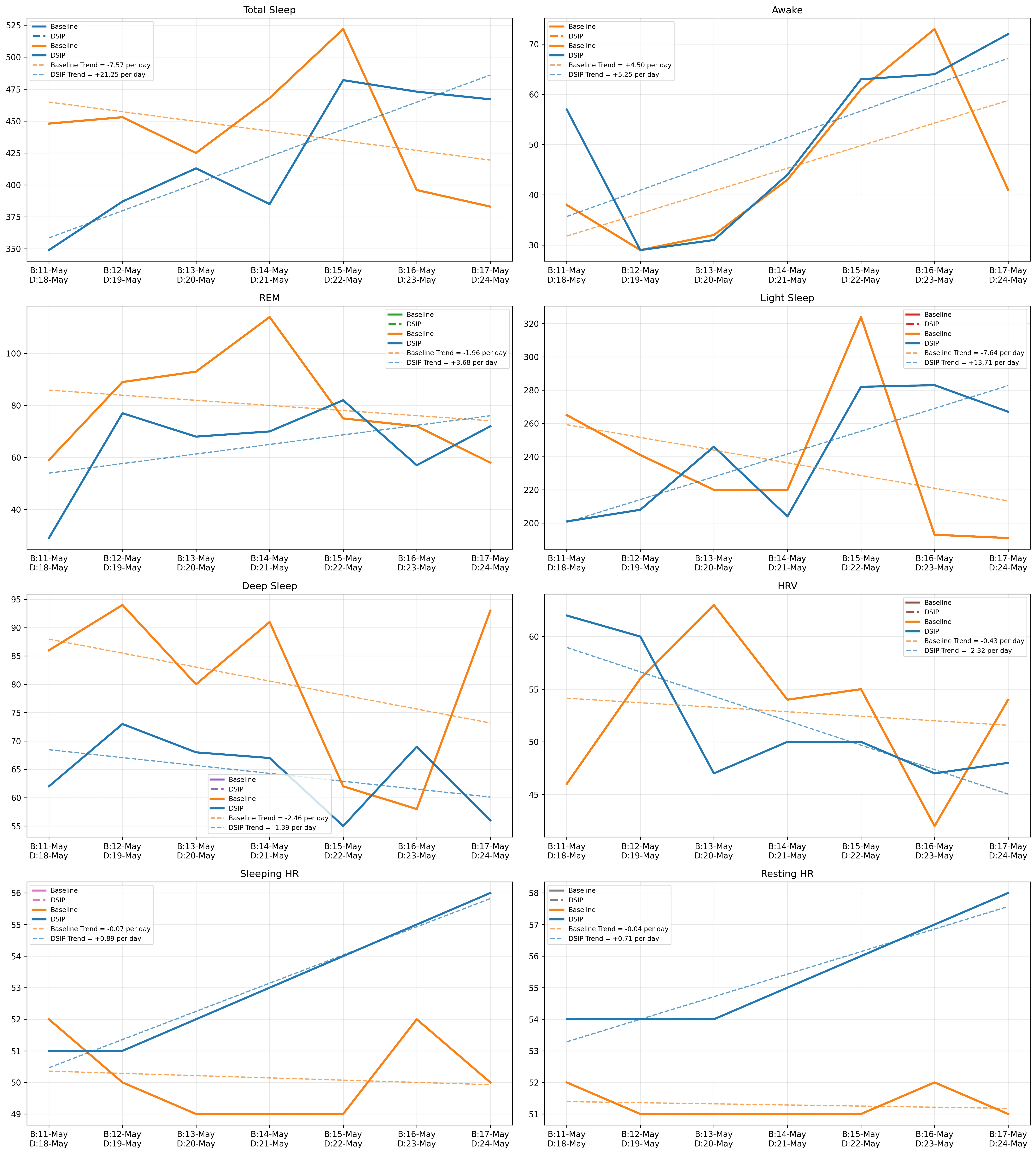
Nightly total sleep time climbed steadily the longer DSIP was used, with an average gain of roughly +20 minutes of sleep per night across the 7 day dosing period.

Against baseline, almost every DSIP night showed markedly less deep sleep and REM sleep alongside considerably more total sleep, with the added sleep concentrated in light sleep.

Sleeping HR and RHR rose by roughly 1 bpm per day throughout the DSIP trial (about +6 bpm to my heart rate over 7 days while taking DSIP). HRV declined over the same period.

Light sleep rose substantially while on DSIP, trending up roughly 15 minutes per night. REM sleep also rose modestly, trending about +4 minutes per night, though it stayed below baseline.

Subjective Experience

My goal was deeper, more restful sleep. What I got was the reverse. I did not feel especially drowsy after dosing, and during the night I actually tended to wake consciously more often than without it, with more difficulty getting back to sleep. My fitness tracker counts micro-awake periods as "Awake" time, but on most nights I am not consciously awake during those... while on DSIP I had frequent Awake periods where I was fully conscious and had trouble falling back asleep.

Despite the longer total sleep time on DSIP, my sleep quality was far worse (see above). Every morning I woke feeling progressively less refreshed.

Looking at the figure below, the biggest gains were almost entirely in "Light Sleep," which is not ideal, that is junk sleep... Light Sleep is time spent neither awake nor healing/restoring.

The rise in my RHR supports the idea that my sleep was not merely less refreshing in feel, it genuinely was, since RHR is among the earliest markers to climb under systemic stress.

I am very attuned to my body and know it well as an endurance athlete. During the DSIP period I noticed my muscles were not recovering as quickly. I train 20 hours a week with intense cardio and weight lifting, and I have been doing this a long time, I know how my body reacts, and what level of training it can handle. My training routine felt harder each day, and my body never seemed to recover from sessions 2-3 days earlier, which normally never happens to me

Conclusion

I do not recommend DSIP. My quality of sleep decreased and time spent recovering between training sessions increased.

Figures


41012c3645a83b48a9bbc72bc8393119d032b9f335cdc8f22cfcc2f961765d67.webp


My own experience with DSIP didn't leave me impressed either.

That said, whenever dosing information gets published (often lacking any real scientific grounding), I notice a pull toward extremely cautious amounts. Nobody wants to be the person blamed for harm after advising others to use 1 or 2 mg of DSIP. As a result, the guidance often ends up being to stay at or below 500mcg, with advice to begin at a far lower level still.

Because of that, I suspect some people never reach the upside that a bigger dose could offer. I've come across discussion around BPC-157 suggesting we genuinely don't know where the ceiling should be. I believe I've even seen it said that no dose high enough to cause harm has been identified yet, at least in lab animals. This habit of keeping dosing inside very cautious limits may mean BPC-157's potential gets downplayed or underestimated.
 
FartfulCodger said:

My own experience with DSIP didn't leave me impressed either.

That said, whenever dosing information gets published (often lacking any real scientific grounding), I notice a pull toward extremely cautious amounts. Nobody wants to be the person blamed for harm after advising others to use 1 or 2 mg of DSIP. As a result, the guidance often ends up being to stay at or below 500mcg, with advice to begin at a far lower level still.

Because of that, I suspect some people never reach the upside that a bigger dose could offer. I've come across discussion around BPC-157 suggesting we genuinely don't know where the ceiling should be. I believe I've even seen it said that no dose high enough to cause harm has been identified yet, at least in lab animals. This habit of keeping dosing inside very cautious limits may mean BPC-157's potential gets downplayed or underestimated.
Where did you get the notion that 1mg counts as conservative?

Medical literature used doses 50% greater than mine... given my body weight, a 25 nmol/kg amount would have required a 1.69mg dose to equal what earlier studies administered.. so my dosing actually sat on the conservative end, and that was deliberate.

  • Schneider-Helmert et al. (1981) — healthy volunteers, 25 nmol/kg IV

    PubMed study link
  • Schneider-Helmert et al. (1982) — chronic insomniacs, 25 nmol/kg

    PubMed study link
  • Schneider-Helmert et al. (1984) — insomnia repeated administration, 25 nmol/kg

    PubMed study link
  • Monti et al. (1987) — insomniacs, 25 nmol/kg over 4 nights

    PubMed study link
  • Pollard et al. (2009) — anesthesia/EEG effects, included 25 nmol/kg arm

    PubMed study link
 
DSIP was a bad experience in my case — my sleep quality clearly got worse. After 5 nights in a row of consistent negative deviation from my baseline, I stopped taking it.

When I stacked it with epithalon, the negative effect was reduced to nearly neutral.

It's just not something that works for me. Any guesses about where I began it?

4252f840d860f1f22fc26fa8983480511d97efd2fffc7f6d57d19a937fe500f2.webp
 
woundcarping said:

DSIP was a bad experience in my case — my sleep quality clearly got worse. After 5 nights in a row of consistent negative deviation from my baseline, I stopped taking it.

When I stacked it with epithalon, the negative effect was reduced to nearly neutral.

It's just not something that works for me. Any guesses about where I began it?

View attachment 11550
That matches my experience exactly.

Across the 7 days, my average sleep duration went up quite a bit. But when you check the charts, my total Deep Sleep time dropped by an average of 35%, and REM sleep fell by roughly 15%. The additional sleep was all Light Sleep, which is low-quality sleep with very little restorative value.

Every morning I felt worse rested than the morning before.
 
wildweasel said:

woundcarping said:

DSIP was a bad experience in my case — my sleep quality clearly got worse. After 5 nights in a row of consistent negative deviation from my baseline, I stopped taking it.

When I stacked it with epithalon, the negative effect was reduced to nearly neutral.

It's just not something that works for me. Any guesses about where I began it?

View attachment 11550
That matches my experience exactly.

Across the 7 days, my average sleep duration went up quite a bit. But when you check the charts, my total Deep Sleep time dropped by an average of 35%, and REM sleep fell by roughly 15%. The additional sleep was all Light Sleep, which is low-quality sleep with very little restorative value.

Every morning I felt worse rested than the morning before.

My overall sleep duration deteriorated fast.

I have very little faith in what my ring reports for the different sleep phases. I haven't looked into how it arrives at those results at all, so I might be completely wrong.
 
A few weeks back I gave intranasal a shot for 7 days. My Rhr climbed by 5 and my hrv dropped hard. I'm curious whether subq would work out better, though once I quit, the problems went away.
 
ladyj779 said:

A few weeks back I gave intranasal a shot for 7 days. My Rhr climbed by 5 and my hrv dropped hard. I'm curious whether subq would work out better, though once I quit, the problems went away.
I went with subq — forgot to mention that earlier 😀

woundcarping said:

wildweasel said:

woundcarping said:

DSIP was a bad experience in my case — my sleep quality clearly got worse. After 5 nights in a row of consistent negative deviation from my baseline, I stopped taking it.

When I stacked it with epithalon, the negative effect was reduced to nearly neutral.

It's just not something that works for me. Any guesses about where I began it?

View attachment 11550
That matches my experience exactly.

Across the 7 days, my average sleep duration went up quite a bit. But when you check the charts, my total Deep Sleep time dropped by an average of 35%, and REM sleep fell by roughly 15%. The additional sleep was all Light Sleep, which is low-quality sleep with very little restorative value.

Every morning I felt worse rested than the morning before.

My overall sleep duration deteriorated fast.

I have very little faith in what my ring reports for the different sleep phases. I haven't looked into how it arrives at those results at all, so I might be completely wrong.
Yeah, I'd say fitness trackers aren't great at nailing sleep stages, but it's a bit like BFA scales: you figure they'll be off by a certain %, yet they still work for watching trends across time
 
woundcarping said:

DSIP was a bad experience in my case — my sleep quality clearly got worse. After 5 nights in a row of consistent negative deviation from my baseline, I stopped taking it.

When I stacked it with epithalon, the negative effect was reduced to nearly neutral.

It's just not something that works for me. Any guesses about where I began it?

View attachment 11550
Clearly 😀
 
ladyj779 said:

A few weeks back I gave intranasal a shot for 7 days. My Rhr climbed by 5 and my hrv dropped hard. I'm curious whether subq would work out better, though once I quit, the problems went away.

That's curious — my RHR climbed a bit over that stretch, though it's likely just beyond the noise ratio coming from the ring and watch data. On my watch, HRV stayed mostly unremarkable, but it dropped on the ring.

I don't plan on running any further DSIP experiments. Normally my sleep isn't "bad," yet it deteriorated fast, and that lined up with the 5-day stretch I used it without epithalon.

My route was SQ as well. Doses were .330mg and .660mg solo, plus .495mg when stacked with epi.
 
So from what I'm gathering, switching to subq probably wouldn't be worth the effort — it seems like the result would end up the same as what I got with in
 
wildweasel said:

Context

As someone who competes in endurance events, the idea that DSIP could promote deep sleep caught my attention, given that its full name is "Deep Sleep Inducing Peptide."

I ran a 7 day self-experiment and wanted to report what happened. Being strongly data-oriented, whenever I look into a new peptide or compound, I prefer to design a quantitative test so results can actually be judged.

If you only want the bottom line: [[Q1]]

What the Medical Literature Says

DSIP first came to light in the 1970s, drawing interest after early animal work and a few small human studies hinted that it could shape sleep architecture, particularly slow-wave sleep and how long it takes to fall asleep.

The human evidence is very thin, contradictory and mostly poor quality by today's standards. A few studies found better sleep quality or sedation-like effects, others found higher heart rates with no sleep changes, and still others turned up nothing meaningful at all.

What makes DSIP unusual is that no definitive receptor, precursor protein or even a fully confirmed endogenous biological function has ever been clearly pinned down, which is part of why the peptide remains contentious in the literature.

All told, the present state of medical literature is probably best summarized as: [[Q2]]

How I Tested It

14 day trial. 7 days captured as a baseline, 7 days captured dosing 1mg DSIP subq about 30-45 before bed.

A wearable fitness tracker supplied the data, logging sleep stages (REM, deep, light and awake time each night), sleeping heart rate, heart rate variability (HRV) and daytime resting heart rate (RHR).

Summary of My Results

Nightly total sleep time climbed steadily the longer DSIP was used, with an average gain of roughly +20 minutes of sleep per night across the 7 day dosing period.

Against baseline, almost every DSIP night showed markedly less deep sleep and REM sleep alongside considerably more total sleep, with the added sleep concentrated in light sleep.

Sleeping HR and RHR rose by roughly 1 bpm per day throughout the DSIP trial (about +6 bpm to my heart rate over 7 days while taking DSIP). HRV declined over the same period.

Light sleep rose substantially while on DSIP, trending up roughly 15 minutes per night. REM sleep also rose modestly, trending about +4 minutes per night, though it stayed below baseline.

Subjective Experience

My goal was deeper, more restful sleep. What I got was the reverse. I did not feel especially drowsy after dosing, and during the night I actually tended to wake consciously more often than without it, with more difficulty getting back to sleep. My fitness tracker counts micro-awake periods as "Awake" time, but on most nights I am not consciously awake during those... while on DSIP I had frequent Awake periods where I was fully conscious and had trouble falling back asleep.

Despite the longer total sleep time on DSIP, my sleep quality was far worse (see above). Every morning I woke feeling progressively less refreshed.

Looking at the figure below, the biggest gains were almost entirely in "Light Sleep," which is not ideal, that is junk sleep... Light Sleep is time spent neither awake nor healing/restoring.

The rise in my RHR supports the idea that my sleep was not merely less refreshing in feel, it genuinely was, since RHR is among the earliest markers to climb under systemic stress.

I am very attuned to my body and know it well as an endurance athlete. During the DSIP period I noticed my muscles were not recovering as quickly. I train 20 hours a week with intense cardio and weight lifting, and I have been doing this a long time, I know how my body reacts, and what level of training it can handle. My training routine felt harder each day, and my body never seemed to recover from sessions 2-3 days earlier, which normally never happens to me

Conclusion

I do not recommend DSIP. My quality of sleep decreased and time spent recovering between training sessions increased.

Figures


View attachment 11549

That's genuinely fascinating. I appreciate you posting this. Could it have suppressed your growth hormone output?
 
Quite fascinating. For 10 years I have struggled to feel rested, as I deal with narcolepsy/fibromyalgia.

48 hours after dosing DSIP, my fitness tracker (accuracy uncertain) shows far less awake time along with greater deep/REM sleep. It has benefited me enormously.
 
Appreciate the thorough breakdown. It lines up closely with what I went through. My starting point was 200ugm, and I worked my way up to 1mg. As the dose climbed, my sleep measurements got worse and I woke up feeling less refreshed. Good thing I didn't begin with a kit.

Sadly, apart from the compounds big pharma already sells or has in late stage trials, I still haven't come across a peptide with a clear upside. The search continues, though.

My hope was to push my deep sleep numbers out of the single digits or teens on a good night, but DSIP won't be the one to do it.
 
it blows my mind how peptides can hit people so differently. i'm known for being an extremely light sleeper, and my sleep quality is awful. to the point where my wife simply entering the room while i'm out cold would jolt me awake because of the shift in air pressure. or she'd ask me something and i'd rattle off exactly where those fabric scissors are in the hobby room lol. i'm roughly 1 vial into trying it, already have a few more headed my way, and i'm waiting on a group buy that's coming up so i can stock up for life.

the first night i began with a low dose of 100mcg and increased by 50mcg daily until i reached my current 500mcg. even that first night i had dreams! something i hadn't had in...well idk maybe more than a decade, i'm not even sure. after that long you just don't remember the last time you slept well enough to actually dream.

i don't own a sleep tracker, so i have no hard data. i gave a couple of them a try for a while, but none would ever record anything. i guess my sleep was so bad it never picked up that i was actually asleep or something idk. just going by feel, though, i feel better than i have in my whole adult life (im 34)

that said, my situation is probably not like most people's. i work evening shift, so i sleep from 8am-3pm, and i've been on that schedule since i was 18, so i honestly don't know anything different at this point. i've read it was studied for exactly that reason, shift workers on off schedules, and at least in my case it's been great.
 
When a tough day leaves me wired, I'll use DSIP 1 to 2 times per week. My tracking covers weight at waking and again in the afternoon, BP, HR, energy (admittedly subjective), plus sleep duration, sleep quality, and average resting heart rate from Fitbit and Apple Watch. My numbers clearly improve with DSIP.

With more than 100 data points on my end, I question whether your sample size is large enough. Still, I get it—once you know, data or no data, you just know.

Thx for sharing your data.
 
bbbilly said:

it blows my mind how peptides can hit people so differently. i'm known for being an extremely light sleeper, and my sleep quality is awful. to the point where my wife simply entering the room while i'm out cold would jolt me awake because of the shift in air pressure. or she'd ask me something and i'd rattle off exactly where those fabric scissors are in the hobby room lol. i'm roughly 1 vial into trying it, already have a few more headed my way, and i'm waiting on a group buy that's coming up so i can stock up for life.

the first night i began with a low dose of 100mcg and increased by 50mcg daily until i reached my current 500mcg. even that first night i had dreams! something i hadn't had in...well idk maybe more than a decade, i'm not even sure. after that long you just don't remember the last time you slept well enough to actually dream.

i don't own a sleep tracker, so i have no hard data. i gave a couple of them a try for a while, but none would ever record anything. i guess my sleep was so bad it never picked up that i was actually asleep or something idk. just going by feel, though, i feel better than i have in my whole adult life (im 34)

that said, my situation is probably not like most people's. i work evening shift, so i sleep from 8am-3pm, and i've been on that schedule since i was 18, so i honestly don't know anything different at this point. i've read it was studied for exactly that reason, shift workers on off schedules, and at least in my case it's been great.

The one non-negative change I picked up on was an increase in dreaming. Whether I actually dreamed more often, or simply recalled dreams better — waking mid-dream, which made it feel like "more dreaming" — I can't say.
 
it amazes me that within this thread, certain folks describe the same thing happening to them as I went through, while others went through something totally different.

the medical literature itself was all over the place — a few sources listed positives, a few said there was nothing, and a few mentioned negative reactions. that honestly looks like what's going on here too; this peptide just doesn't behave in a way you can count on, or at least that's how it comes across
 
bbbilly said:

it blows my mind how peptides can hit people so differently. i'm known for being an extremely light sleeper, and my sleep quality is awful. to the point where my wife simply entering the room while i'm out cold would jolt me awake because of the shift in air pressure. or she'd ask me something and i'd rattle off exactly where those fabric scissors are in the hobby room lol. i'm roughly 1 vial into trying it, already have a few more headed my way, and i'm waiting on a group buy that's coming up so i can stock up for life.

the first night i began with a low dose of 100mcg and increased by 50mcg daily until i reached my current 500mcg. even that first night i had dreams! something i hadn't had in...well idk maybe more than a decade, i'm not even sure. after that long you just don't remember the last time you slept well enough to actually dream.

i don't own a sleep tracker, so i have no hard data. i gave a couple of them a try for a while, but none would ever record anything. i guess my sleep was so bad it never picked up that i was actually asleep or something idk. just going by feel, though, i feel better than i have in my whole adult life (im 34)

that said, my situation is probably not like most people's. i work evening shift, so i sleep from 8am-3pm, and i've been on that schedule since i was 18, so i honestly don't know anything different at this point. i've read it was studied for exactly that reason, shift workers on off schedules, and at least in my case it's been great.
On its own, DSIP produced no such result for me. Once I dropped it and switched over to sermorelin, though, my dreams shifted from a faint sense that I was dreaming to noticeably stronger recall, lasting roughly 1 week, after which things returned to the way they had been. I can't tell whether some lingering DSIP effect carried over into the sermorelin combination, or whether the whole thing was pure coincidence. With tesa, or with tesa plus DSIP, it doesn't appear to occur. At some point I may need to revisit that original pairing and try to work out whether I can reproduce it in myself.
 
Back
Top