

wildweasel
Explorer
Context
As someone who competes in endurance events, the idea that DSIP could promote deep sleep caught my attention, given that its full name is "Deep Sleep Inducing Peptide."
I ran a 7 day self-experiment and wanted to report what happened. Being strongly data-oriented, whenever I look into a new peptide or compound, I prefer to design a quantitative test so results can actually be judged.
If you only want the bottom line: [[Q1]]
What the Medical Literature Says
DSIP first came to light in the 1970s, drawing interest after early animal work and a few small human studies hinted that it could shape sleep architecture, particularly slow-wave sleep and how long it takes to fall asleep.
The human evidence is very thin, contradictory and mostly poor quality by today's standards. A few studies found better sleep quality or sedation-like effects, others found higher heart rates with no sleep changes, and still others turned up nothing meaningful at all.
What makes DSIP unusual is that no definitive receptor, precursor protein or even a fully confirmed endogenous biological function has ever been clearly pinned down, which is part of why the peptide remains contentious in the literature.
All told, the present state of medical literature is probably best summarized as: [[Q2]]
How I Tested It
14 day trial. 7 days captured as a baseline, 7 days captured dosing 1mg DSIP subq about 30-45 before bed.
A wearable fitness tracker supplied the data, logging sleep stages (REM, deep, light and awake time each night), sleeping heart rate, heart rate variability (HRV) and daytime resting heart rate (RHR).
Summary of My Results
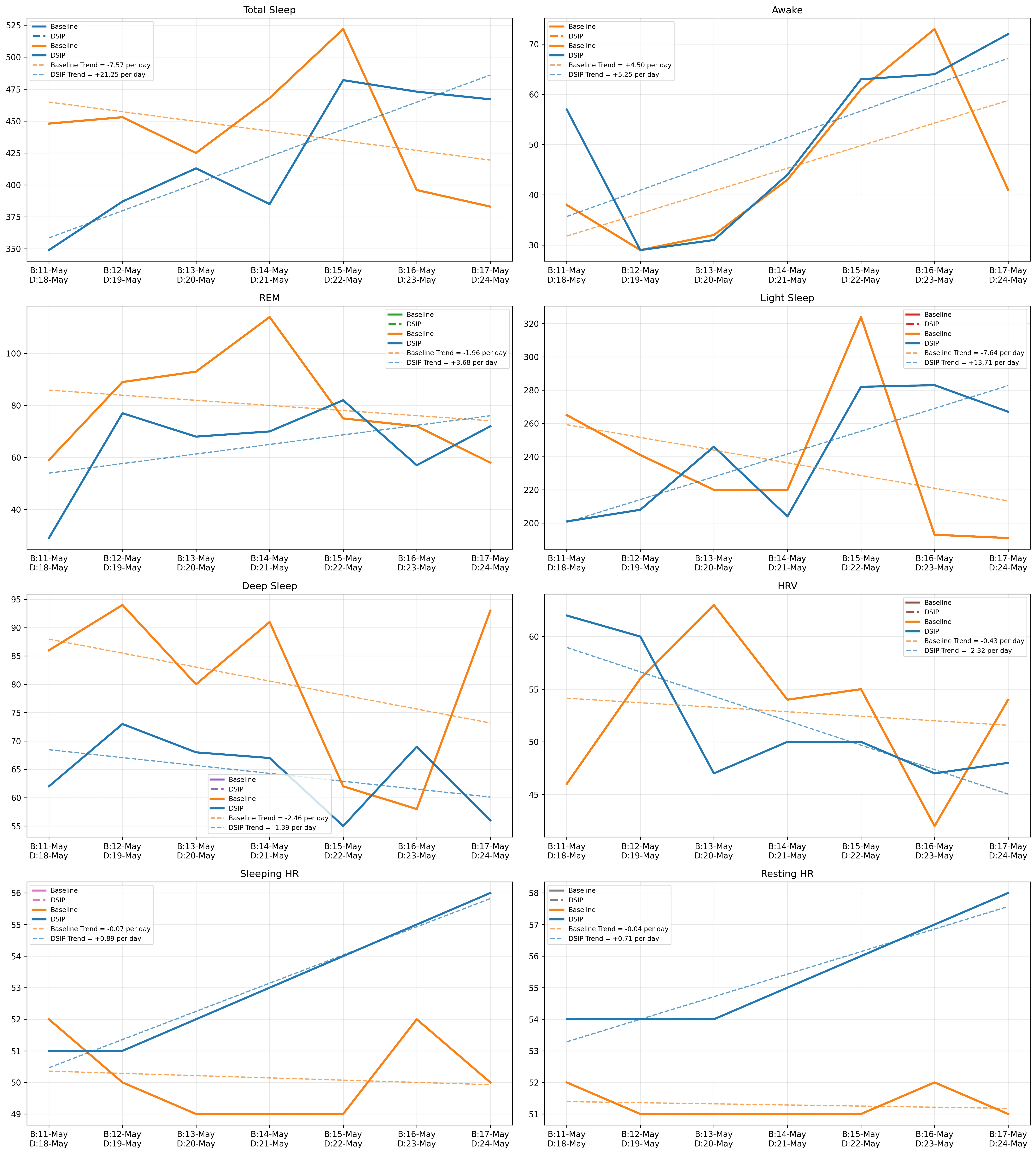
Nightly total sleep time climbed steadily the longer DSIP was used, with an average gain of roughly +20 minutes of sleep per night across the 7 day dosing period.
Against baseline, almost every DSIP night showed markedly less deep sleep and REM sleep alongside considerably more total sleep, with the added sleep concentrated in light sleep.
Sleeping HR and RHR rose by roughly 1 bpm per day throughout the DSIP trial (about +6 bpm to my heart rate over 7 days while taking DSIP). HRV declined over the same period.
Light sleep rose substantially while on DSIP, trending up roughly 15 minutes per night. REM sleep also rose modestly, trending about +4 minutes per night, though it stayed below baseline.
Subjective Experience
My goal was deeper, more restful sleep. What I got was the reverse. I did not feel especially drowsy after dosing, and during the night I actually tended to wake consciously more often than without it, with more difficulty getting back to sleep. My fitness tracker counts micro-awake periods as "Awake" time, but on most nights I am not consciously awake during those... while on DSIP I had frequent Awake periods where I was fully conscious and had trouble falling back asleep.
Despite the longer total sleep time on DSIP, my sleep quality was far worse (see above). Every morning I woke feeling progressively less refreshed.
Looking at the figure below, the biggest gains were almost entirely in "Light Sleep," which is not ideal, that is junk sleep... Light Sleep is time spent neither awake nor healing/restoring.
The rise in my RHR supports the idea that my sleep was not merely less refreshing in feel, it genuinely was, since RHR is among the earliest markers to climb under systemic stress.
I am very attuned to my body and know it well as an endurance athlete. During the DSIP period I noticed my muscles were not recovering as quickly. I train 20 hours a week with intense cardio and weight lifting, and I have been doing this a long time, I know how my body reacts, and what level of training it can handle. My training routine felt harder each day, and my body never seemed to recover from sessions 2-3 days earlier, which normally never happens to me
Conclusion
I do not recommend DSIP. My quality of sleep decreased and time spent recovering between training sessions increased.
Figures
As someone who competes in endurance events, the idea that DSIP could promote deep sleep caught my attention, given that its full name is "Deep Sleep Inducing Peptide."
I ran a 7 day self-experiment and wanted to report what happened. Being strongly data-oriented, whenever I look into a new peptide or compound, I prefer to design a quantitative test so results can actually be judged.
If you only want the bottom line: [[Q1]]
What the Medical Literature Says
DSIP first came to light in the 1970s, drawing interest after early animal work and a few small human studies hinted that it could shape sleep architecture, particularly slow-wave sleep and how long it takes to fall asleep.
The human evidence is very thin, contradictory and mostly poor quality by today's standards. A few studies found better sleep quality or sedation-like effects, others found higher heart rates with no sleep changes, and still others turned up nothing meaningful at all.
What makes DSIP unusual is that no definitive receptor, precursor protein or even a fully confirmed endogenous biological function has ever been clearly pinned down, which is part of why the peptide remains contentious in the literature.
All told, the present state of medical literature is probably best summarized as: [[Q2]]
How I Tested It
14 day trial. 7 days captured as a baseline, 7 days captured dosing 1mg DSIP subq about 30-45 before bed.
A wearable fitness tracker supplied the data, logging sleep stages (REM, deep, light and awake time each night), sleeping heart rate, heart rate variability (HRV) and daytime resting heart rate (RHR).
Summary of My Results
Nightly total sleep time climbed steadily the longer DSIP was used, with an average gain of roughly +20 minutes of sleep per night across the 7 day dosing period.
Against baseline, almost every DSIP night showed markedly less deep sleep and REM sleep alongside considerably more total sleep, with the added sleep concentrated in light sleep.
Sleeping HR and RHR rose by roughly 1 bpm per day throughout the DSIP trial (about +6 bpm to my heart rate over 7 days while taking DSIP). HRV declined over the same period.
Light sleep rose substantially while on DSIP, trending up roughly 15 minutes per night. REM sleep also rose modestly, trending about +4 minutes per night, though it stayed below baseline.
Subjective Experience
My goal was deeper, more restful sleep. What I got was the reverse. I did not feel especially drowsy after dosing, and during the night I actually tended to wake consciously more often than without it, with more difficulty getting back to sleep. My fitness tracker counts micro-awake periods as "Awake" time, but on most nights I am not consciously awake during those... while on DSIP I had frequent Awake periods where I was fully conscious and had trouble falling back asleep.
Despite the longer total sleep time on DSIP, my sleep quality was far worse (see above). Every morning I woke feeling progressively less refreshed.
Looking at the figure below, the biggest gains were almost entirely in "Light Sleep," which is not ideal, that is junk sleep... Light Sleep is time spent neither awake nor healing/restoring.
The rise in my RHR supports the idea that my sleep was not merely less refreshing in feel, it genuinely was, since RHR is among the earliest markers to climb under systemic stress.
I am very attuned to my body and know it well as an endurance athlete. During the DSIP period I noticed my muscles were not recovering as quickly. I train 20 hours a week with intense cardio and weight lifting, and I have been doing this a long time, I know how my body reacts, and what level of training it can handle. My training routine felt harder each day, and my body never seemed to recover from sessions 2-3 days earlier, which normally never happens to me
Conclusion
I do not recommend DSIP. My quality of sleep decreased and time spent recovering between training sessions increased.
Figures


