
The "4mg reta glucagon" rule — where it comes from

tubby

Explorer
Joined
Nov 28, 2025
Messages
244
Reaction score
0
Location
Minnesota
Saw this crop up again today and thought a post that tackles the topic properly would be worth having. The usual claim is that reta behaves the same as tirzepatide under 4mg, or that the glucagon agonist only "kicks in" once you reach that level.

The 4mg figure is a myth kept alive by one person misreading a phase 1 trial. Participants in that trial got single reta doses and had various markers tracked afterwards. The 3mg arm was the lowest one where serum glucagon dropped meaningfully below its own baseline, and somewhere along the way that got rounded up to 4mg, because 3mg dosing never carried into the phase 2 work.
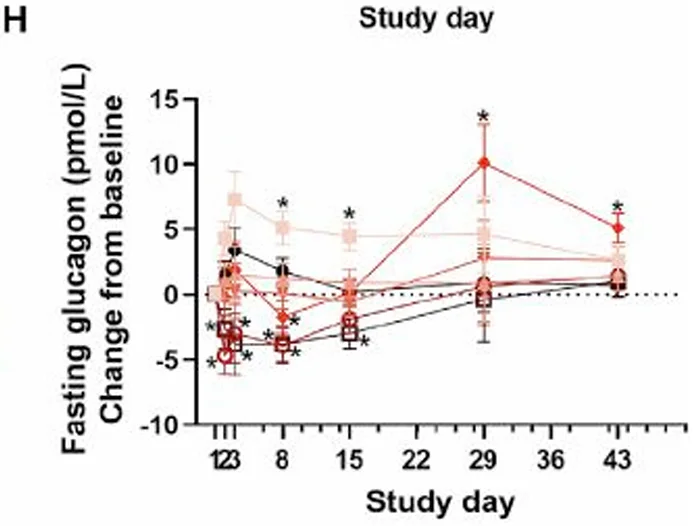



0862102bd81c2634621d5a6d1bf87bcad45a307e431a86e2f8969db59c88cacd.webp


3036d611d9e343e438fbd50c0c7492e75ce5d3217a18980c8e9c40e1485105d3.webp


Why that reasoning does not hold up:

1: One 4mg hit lands at a peak that is roughly what a weekly 2mg routine produces (drugs accumulate over time). A weekly 4mg routine would instead swing from about 8mg total down to 4mg just before the next shot. Comparing one injection against a weekly schedule is not apples to apples.

2: Nothing says every individual will see glucagon drop at the same dose, because insulin and glucagon vary a lot between people (and baselines can run high in someone who is obese or diabetic). A person with less insulin resistance would probably hit that same result on lower reta dosing, whereas a more insulin resistant person would need a bigger dose before it shows. On top of that, the target keeps moving as treatment goes on, since insulin resistance itself changes too.

3: Serum glucagon on its own is not a standalone metric. Metabolism is governed by the ratio of insulin to glucagon. Any GLP already nudges baseline insulin up a little. So even before glucagon agonism enters the picture, the body will naturally push glucagon up in reply to a GLP. You can see exactly that in the same phase 1 trial, where glucagon rises on a very low reta dose. So reading "unchanged" glucagon at a low dose misses most of the story. The better reading is "balanced," because that is the point where the glucagon agonist is offsetting the GLP-1 RA’s tendency to raise glucagon. 4mg is merely where the glucagon agonist started to win.

Worth adding:

Worth pointing out as well that 99% of influencers have no clue what a shift in glucagon level even signifies. Lowering glucagon is not the aim with reta. A GLP-1 agonist can be read as counterfeit GLP-1, and in the same spirit the glucagon agonist in reta is "counterfeit glucagon." A lower reading for real glucagon in blood matters because it tells you the body has decided glucagon is running too high (it senses all that counterfeit glucagon) and is dialling back how much it makes. It means the body is both being "fooled" by the counterfeit glucagon and convinced that current glucagon levels are excessive.

The normal pattern is that glucagon climbs when you have gone several hours without food, then settles back after a carb-containing meal. A glucagon agonist overrides that and convinces the body the levels never come down. In practice this appears to keep metabolism elevated, and to drive other processes that overall look helpful for people with obesity and/or diabetes and that support weight loss, though I would not claim the precise biochemical reason for it is fully settled.

None of this means 4mg is a bad level or anything of the sort. It just means there is nothing magical or special about that number compared with any other.
66109437b0828eb56a01828fc628fabddd46762afc916109d1688a4bcc436d53.webp
 
Nice write-up — I had been convinced that pushing straight to 8mg was the only way to get a real effect. From now on I'll stay at 6mg for as long as possible.
 
Responses clearly vary from person to person. I've been taking 1mg for close to 11 weeks. My starting weight was 328, and I'm down 25lbs (7.6%, which beats the trial figures for 1mg), plus my waist has shrunk by 4 inches, so in my case 1mg seems to be handling visceral fat quite effectively too. That said, I've also changed how I eat and I train 3 times per week. It all adds up.
 
deleted.user.26 said:

Responses clearly vary from person to person. I've been taking 1mg for close to 11 weeks. My starting weight was 328, and I'm down 25lbs (7.6%, which beats the trial figures for 1mg), plus my waist has shrunk by 4 inches, so in my case 1mg seems to be handling visceral fat quite effectively too. That said, I've also changed how I eat and I train 3 times per week. It all adds up.
Absolutely, there's a lot of individual variation. What you're looking at is a waterfall plot: every line is 1 participant's outcome from a phase 2 trial, grouped by dose, and arranged from smallest to largest so the distribution and the typical response become visible.

e53d7ce38be638144b1e24f94df48e56d377897717692675b8449547bbceec1f.webp
 
tubby said:

deleted.user.26 said:

Responses clearly vary from person to person. I've been taking 1mg for close to 11 weeks. My starting weight was 328, and I'm down 25lbs (7.6%, which beats the trial figures for 1mg), plus my waist has shrunk by 4 inches, so in my case 1mg seems to be handling visceral fat quite effectively too. That said, I've also changed how I eat and I train 3 times per week. It all adds up.
Absolutely, there's a lot of individual variation. What you're looking at is a waterfall plot: every line is 1 participant's outcome from a phase 2 trial, grouped by dose, and arranged from smallest to largest so the distribution and the typical response become visible.

View attachment 11327
That's worth noting. The shift from 1mg to the other doses is clear. For the majority, 4-12 shows hardly any variation; the charts look nearly identical.
 
Appreciate it, tubby. From what I can tell looking at those waterfall graphs, the biggest effect—both in how many people respond and how much they lose—shows up somewhere between 4 and 8mg. Past that point, you do get more, but each step adds less than the last.
 
deleted.user.26 said:

tubby said:

deleted.user.26 said:

Responses clearly vary from person to person. I've been taking 1mg for close to 11 weeks. My starting weight was 328, and I'm down 25lbs (7.6%, which beats the trial figures for 1mg), plus my waist has shrunk by 4 inches, so in my case 1mg seems to be handling visceral fat quite effectively too. That said, I've also changed how I eat and I train 3 times per week. It all adds up.
Absolutely, there's a lot of individual variation. What you're looking at is a waterfall plot: every line is 1 participant's outcome from a phase 2 trial, grouped by dose, and arranged from smallest to largest so the distribution and the typical response become visible.

View attachment 11327
That's worth noting. The shift from 1mg to the other doses is clear. For the majority, 4-12 shows hardly any variation; the charts look nearly identical.
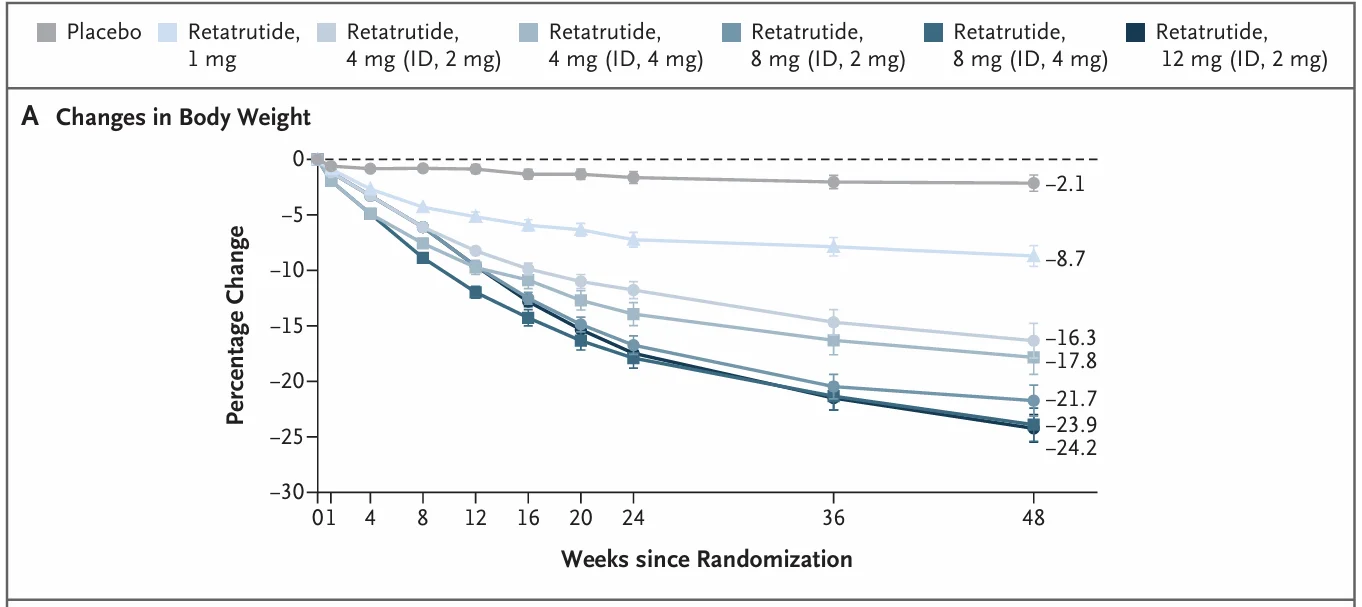
To get a sense of how the averages diverge, I'd suggest revisiting the graph included in the original post. Waterfall plots make those average differences much tougher to pick out.
 
Sid the SeaGull said:

Appreciate it, tubby. From what I can tell looking at those waterfall graphs, the biggest effect—both in how many people respond and how much they lose—shows up somewhere between 4 and 8mg. Past that point, you do get more, but each step adds less than the last.
Diminishing returns will definitely play some role, but remember that this comes from a 48 week study where the curves for the 8mg and 12mg arms have not yet begun to flatten.
 
tubby said:

Sid the SeaGull said:

Appreciate it, tubby. From what I can tell looking at those waterfall graphs, the biggest effect—both in how many people respond and how much they lose—shows up somewhere between 4 and 8mg. Past that point, you do get more, but each step adds less than the last.
Diminishing returns will definitely play some role, but remember that this comes from a 48 week study where the curves for the 8mg and 12mg arms have not yet begun to flatten.

That's a solid observation — when investors are pushing hard for outcomes and profits, a trial can only go on for so long, I suppose.

It really leaves me asking what might have been seen at the larger doses had they been allowed more time. The Reta itself, along with the real-world data that's been gathered, is impressive. From where I sit, this was a prize-worthy post — thanks.
 
Sid the SeaGull said:

Nice write-up — I had been convinced that pushing straight to 8mg was the only way to get a real effect. From now on I'll stay at 6mg for as long as possible.

My plan was to remain at 6 for a good while as well. 6mg over 6 weeks went really well, then the final 2 weeks really tapered off. Spent 2 weeks at 7mg with no real change. So far 8mg has been excellent—Friday was my first injection, and it finally feels like Reta is working again. Unless you've experienced it, it's tough to put into words.
 
I started Reta in January and ramped up to 8mg quite fast, since I was relying on incorrect info. Given what's shared here, 4mg should easily cover the rest of my weight loss. I've already dropped 85# and although I could stop where I am, I'd like to shed another 15# so I can hit that psychological 100# milestone. Appreciate the post!
 
tubby said:

Saw this crop up again today and thought a post that tackles the topic properly would be worth having. The usual claim is that reta behaves the same as tirzepatide under 4mg, or that the glucagon agonist only "kicks in" once you reach that level.

The 4mg figure is a myth kept alive by one person misreading a phase 1 trial. Participants in that trial got single reta doses and had various markers tracked afterwards. The 3mg arm was the lowest one where serum glucagon dropped meaningfully below its own baseline, and somewhere along the way that got rounded up to 4mg, because 3mg dosing never carried into the phase 2 work.


View attachment 11324

View attachment 11325

Why that reasoning does not hold up:

1: One 4mg hit lands at a peak that is roughly what a weekly 2mg routine produces (drugs accumulate over time). A weekly 4mg routine would instead swing from about 8mg total down to 4mg just before the next shot. Comparing one injection against a weekly schedule is not apples to apples.

2: Nothing says every individual will see glucagon drop at the same dose, because insulin and glucagon vary a lot between people (and baselines can run high in someone who is obese or diabetic). A person with less insulin resistance would probably hit that same result on lower reta dosing, whereas a more insulin resistant person would need a bigger dose before it shows. On top of that, the target keeps moving as treatment goes on, since insulin resistance itself changes too.

3: Serum glucagon on its own is not a standalone metric. Metabolism is governed by the ratio of insulin to glucagon. Any GLP already nudges baseline insulin up a little. So even before glucagon agonism enters the picture, the body will naturally push glucagon up in reply to a GLP. You can see exactly that in the same phase 1 trial, where glucagon rises on a very low reta dose. So reading "unchanged" glucagon at a low dose misses most of the story. The better reading is "balanced," because that is the point where the glucagon agonist is offsetting the GLP-1 RA’s tendency to raise glucagon. 4mg is merely where the glucagon agonist started to win.

Worth adding:

Worth pointing out as well that 99% of influencers have no clue what a shift in glucagon level even signifies. Lowering glucagon is not the aim with reta. A GLP-1 agonist can be read as counterfeit GLP-1, and in the same spirit the glucagon agonist in reta is "counterfeit glucagon." A lower reading for real glucagon in blood matters because it tells you the body has decided glucagon is running too high (it senses all that counterfeit glucagon) and is dialling back how much it makes. It means the body is both being "fooled" by the counterfeit glucagon and convinced that current glucagon levels are excessive.

The normal pattern is that glucagon climbs when you have gone several hours without food, then settles back after a carb-containing meal. A glucagon agonist overrides that and convinces the body the levels never come down. In practice this appears to keep metabolism elevated, and to drive other processes that overall look helpful for people with obesity and/or diabetes and that support weight loss, though I would not claim the precise biochemical reason for it is fully settled.

None of this means 4mg is a bad level or anything of the sort. It just means there is nothing magical or special about that number compared with any other.

View attachment 11326
Appreciate it, @tubby.

This misconception pushed me to keep raising my dose, leaving me worried I wasn't using it correctly to get the effects I wanted. That urge to fix years of harm instantly can hit hard.
 
BNLFL said:

Sid the SeaGull said:

Nice write-up — I had been convinced that pushing straight to 8mg was the only way to get a real effect. From now on I'll stay at 6mg for as long as possible.

My plan was to remain at 6 for a good while as well. 6mg over 6 weeks went really well, then the final 2 weeks really tapered off. Spent 2 weeks at 7mg with no real change. So far 8mg has been excellent—Friday was my first injection, and it finally feels like Reta is working again. Unless you've experienced it, it's tough to put into words.
I've been after that feeling for 3 weeks now

next week it either happens or I'm back to stomach trouble 🙂
 
Sid the SeaGull said:

Appreciate it, tubby. From what I can tell looking at those waterfall graphs, the biggest effect—both in how many people respond and how much they lose—shows up somewhere between 4 and 8mg. Past that point, you do get more, but each step adds less than the last.
So you're telling me that at 4mg some kind of magic kicks in, yet it isn't the legendary glucagon agonist activation?
 
tubby said:

Saw this crop up again today and thought a post that tackles the topic properly would be worth having. The usual claim is that reta behaves the same as tirzepatide under 4mg, or that the glucagon agonist only "kicks in" once you reach that level.

The 4mg figure is a myth kept alive by one person misreading a phase 1 trial. Participants in that trial got single reta doses and had various markers tracked afterwards. The 3mg arm was the lowest one where serum glucagon dropped meaningfully below its own baseline, and somewhere along the way that got rounded up to 4mg, because 3mg dosing never carried into the phase 2 work.


View attachment 11324

View attachment 11325

Why that reasoning does not hold up:

1: One 4mg hit lands at a peak that is roughly what a weekly 2mg routine produces (drugs accumulate over time). A weekly 4mg routine would instead swing from about 8mg total down to 4mg just before the next shot. Comparing one injection against a weekly schedule is not apples to apples.

2: Nothing says every individual will see glucagon drop at the same dose, because insulin and glucagon vary a lot between people (and baselines can run high in someone who is obese or diabetic). A person with less insulin resistance would probably hit that same result on lower reta dosing, whereas a more insulin resistant person would need a bigger dose before it shows. On top of that, the target keeps moving as treatment goes on, since insulin resistance itself changes too.

3: Serum glucagon on its own is not a standalone metric. Metabolism is governed by the ratio of insulin to glucagon. Any GLP already nudges baseline insulin up a little. So even before glucagon agonism enters the picture, the body will naturally push glucagon up in reply to a GLP. You can see exactly that in the same phase 1 trial, where glucagon rises on a very low reta dose. So reading "unchanged" glucagon at a low dose misses most of the story. The better reading is "balanced," because that is the point where the glucagon agonist is offsetting the GLP-1 RA’s tendency to raise glucagon. 4mg is merely where the glucagon agonist started to win.

Worth adding:

Worth pointing out as well that 99% of influencers have no clue what a shift in glucagon level even signifies. Lowering glucagon is not the aim with reta. A GLP-1 agonist can be read as counterfeit GLP-1, and in the same spirit the glucagon agonist in reta is "counterfeit glucagon." A lower reading for real glucagon in blood matters because it tells you the body has decided glucagon is running too high (it senses all that counterfeit glucagon) and is dialling back how much it makes. It means the body is both being "fooled" by the counterfeit glucagon and convinced that current glucagon levels are excessive.

The normal pattern is that glucagon climbs when you have gone several hours without food, then settles back after a carb-containing meal. A glucagon agonist overrides that and convinces the body the levels never come down. In practice this appears to keep metabolism elevated, and to drive other processes that overall look helpful for people with obesity and/or diabetes and that support weight loss, though I would not claim the precise biochemical reason for it is fully settled.

None of this means 4mg is a bad level or anything of the sort. It just means there is nothing magical or special about that number compared with any other.

View attachment 11326
I appreciate you laying all of this out. For 9 weeks I've been taking 1mg/week, divided into 2 doses of 0.5mg, and the results have been great. 2 weeks ago I attempted a bump to 1.4mg, but the side effects hurt my gym performance and brought on fatigue I wasn't willing to accept, so I dropped back down and feel significantly better now.

That 4mg claim kept coming up, and since reaching or tolerating such a dose seems impossible for me, I wondered whether I was losing out on the glucagon advantages.

Some background: I'm female, 5'10.5", began at 162.4lb, and after 9 weeks on reta I'm at 138.8lb. I'm about to begin tapering down for maintenance (my reason for starting reta was perimenopausal weight gain).
 
I'm still puzzled about the origin of this whole "baby dose" trend and what makes it effective. No disrespect to those using baby doses. Losing 2.7lbs weekly doesn't add up when you're only taking 1mg/week.
 
Sid the SeaGull said:

Nice write-up — I had been convinced that pushing straight to 8mg was the only way to get a real effect. From now on I'll stay at 6mg for as long as possible.
How many weeks did you stay at 4, and was the move to 6 a direct jump from 4?
 
octopusthorpe said:

tubby said:

Saw this crop up again today and thought a post that tackles the topic properly would be worth having. The usual claim is that reta behaves the same as tirzepatide under 4mg, or that the glucagon agonist only "kicks in" once you reach that level.

The 4mg figure is a myth kept alive by one person misreading a phase 1 trial. Participants in that trial got single reta doses and had various markers tracked afterwards. The 3mg arm was the lowest one where serum glucagon dropped meaningfully below its own baseline, and somewhere along the way that got rounded up to 4mg, because 3mg dosing never carried into the phase 2 work.


View attachment 11324

View attachment 11325

Why that reasoning does not hold up:

1: One 4mg hit lands at a peak that is roughly what a weekly 2mg routine produces (drugs accumulate over time). A weekly 4mg routine would instead swing from about 8mg total down to 4mg just before the next shot. Comparing one injection against a weekly schedule is not apples to apples.

2: Nothing says every individual will see glucagon drop at the same dose, because insulin and glucagon vary a lot between people (and baselines can run high in someone who is obese or diabetic). A person with less insulin resistance would probably hit that same result on lower reta dosing, whereas a more insulin resistant person would need a bigger dose before it shows. On top of that, the target keeps moving as treatment goes on, since insulin resistance itself changes too.

3: Serum glucagon on its own is not a standalone metric. Metabolism is governed by the ratio of insulin to glucagon. Any GLP already nudges baseline insulin up a little. So even before glucagon agonism enters the picture, the body will naturally push glucagon up in reply to a GLP. You can see exactly that in the same phase 1 trial, where glucagon rises on a very low reta dose. So reading "unchanged" glucagon at a low dose misses most of the story. The better reading is "balanced," because that is the point where the glucagon agonist is offsetting the GLP-1 RA’s tendency to raise glucagon. 4mg is merely where the glucagon agonist started to win.

Worth adding:

Worth pointing out as well that 99% of influencers have no clue what a shift in glucagon level even signifies. Lowering glucagon is not the aim with reta. A GLP-1 agonist can be read as counterfeit GLP-1, and in the same spirit the glucagon agonist in reta is "counterfeit glucagon." A lower reading for real glucagon in blood matters because it tells you the body has decided glucagon is running too high (it senses all that counterfeit glucagon) and is dialling back how much it makes. It means the body is both being "fooled" by the counterfeit glucagon and convinced that current glucagon levels are excessive.

The normal pattern is that glucagon climbs when you have gone several hours without food, then settles back after a carb-containing meal. A glucagon agonist overrides that and convinces the body the levels never come down. In practice this appears to keep metabolism elevated, and to drive other processes that overall look helpful for people with obesity and/or diabetes and that support weight loss, though I would not claim the precise biochemical reason for it is fully settled.

None of this means 4mg is a bad level or anything of the sort. It just means there is nothing magical or special about that number compared with any other.

View attachment 11326
I appreciate you laying all of this out. For 9 weeks I've been taking 1mg/week, divided into 2 doses of 0.5mg, and the results have been great. 2 weeks ago I attempted a bump to 1.4mg, but the side effects hurt my gym performance and brought on fatigue I wasn't willing to accept, so I dropped back down and feel significantly better now.

That 4mg claim kept coming up, and since reaching or tolerating such a dose seems impossible for me, I wondered whether I was losing out on the glucagon advantages.

Some background: I'm female, 5'10.5", began at 162.4lb, and after 9 weeks on reta I'm at 138.8lb. I'm about to begin tapering down for maintenance (my reason for starting reta was perimenopausal weight gain).
That's something I've been asking myself too. Perhaps all your system required was a slight push. For years you've looked after yourself and stayed in excellent condition. Then your hormones start drifting out of balance, and that was likely the culprit. So maybe your system only required a small glucagon boost, whereas people who aren't in your condition need larger amounts to cover the deficit they're struggling with. That could explain why longtime dedicated gym people (or those with only a little to lose), and similar cases, can use low doses and get results comparable to others who genuinely require far more help.

As for me, I'm already at 5mg Tirz and 3.5mg Reta, yet over the past month I've dropped only 1.8lbs. It's certainly not what I'm eating (I actually need to eat more and have no appetite). I clearly must need a lot more, since my body has to be missing a great deal, ha ha 🙂
 
WLBLD said:

octopusthorpe said:

tubby said:

Saw this crop up again today and thought a post that tackles the topic properly would be worth having. The usual claim is that reta behaves the same as tirzepatide under 4mg, or that the glucagon agonist only "kicks in" once you reach that level.

The 4mg figure is a myth kept alive by one person misreading a phase 1 trial. Participants in that trial got single reta doses and had various markers tracked afterwards. The 3mg arm was the lowest one where serum glucagon dropped meaningfully below its own baseline, and somewhere along the way that got rounded up to 4mg, because 3mg dosing never carried into the phase 2 work.


View attachment 11324

View attachment 11325

Why that reasoning does not hold up:

1: One 4mg hit lands at a peak that is roughly what a weekly 2mg routine produces (drugs accumulate over time). A weekly 4mg routine would instead swing from about 8mg total down to 4mg just before the next shot. Comparing one injection against a weekly schedule is not apples to apples.

2: Nothing says every individual will see glucagon drop at the same dose, because insulin and glucagon vary a lot between people (and baselines can run high in someone who is obese or diabetic). A person with less insulin resistance would probably hit that same result on lower reta dosing, whereas a more insulin resistant person would need a bigger dose before it shows. On top of that, the target keeps moving as treatment goes on, since insulin resistance itself changes too.

3: Serum glucagon on its own is not a standalone metric. Metabolism is governed by the ratio of insulin to glucagon. Any GLP already nudges baseline insulin up a little. So even before glucagon agonism enters the picture, the body will naturally push glucagon up in reply to a GLP. You can see exactly that in the same phase 1 trial, where glucagon rises on a very low reta dose. So reading "unchanged" glucagon at a low dose misses most of the story. The better reading is "balanced," because that is the point where the glucagon agonist is offsetting the GLP-1 RA’s tendency to raise glucagon. 4mg is merely where the glucagon agonist started to win.

Worth adding:

Worth pointing out as well that 99% of influencers have no clue what a shift in glucagon level even signifies. Lowering glucagon is not the aim with reta. A GLP-1 agonist can be read as counterfeit GLP-1, and in the same spirit the glucagon agonist in reta is "counterfeit glucagon." A lower reading for real glucagon in blood matters because it tells you the body has decided glucagon is running too high (it senses all that counterfeit glucagon) and is dialling back how much it makes. It means the body is both being "fooled" by the counterfeit glucagon and convinced that current glucagon levels are excessive.

The normal pattern is that glucagon climbs when you have gone several hours without food, then settles back after a carb-containing meal. A glucagon agonist overrides that and convinces the body the levels never come down. In practice this appears to keep metabolism elevated, and to drive other processes that overall look helpful for people with obesity and/or diabetes and that support weight loss, though I would not claim the precise biochemical reason for it is fully settled.

None of this means 4mg is a bad level or anything of the sort. It just means there is nothing magical or special about that number compared with any other.

View attachment 11326
I appreciate you laying all of this out. For 9 weeks I've been taking 1mg/week, divided into 2 doses of 0.5mg, and the results have been great. 2 weeks ago I attempted a bump to 1.4mg, but the side effects hurt my gym performance and brought on fatigue I wasn't willing to accept, so I dropped back down and feel significantly better now.

That 4mg claim kept coming up, and since reaching or tolerating such a dose seems impossible for me, I wondered whether I was losing out on the glucagon advantages.

Some background: I'm female, 5'10.5", began at 162.4lb, and after 9 weeks on reta I'm at 138.8lb. I'm about to begin tapering down for maintenance (my reason for starting reta was perimenopausal weight gain).
That's something I've been asking myself too. Perhaps all your system required was a slight push. For years you've looked after yourself and stayed in excellent condition. Then your hormones start drifting out of balance, and that was likely the culprit. So maybe your system only required a small glucagon boost, whereas people who aren't in your condition need larger amounts to cover the deficit they're struggling with. That could explain why longtime dedicated gym people (or those with only a little to lose), and similar cases, can use low doses and get results comparable to others who genuinely require far more help.

As for me, I'm already at 5mg Tirz and 3.5mg Reta, yet over the past month I've dropped only 1.8lbs. It's certainly not what I'm eating (I actually need to eat more and have no appetite). I clearly must need a lot more, since my body has to be missing a great deal, ha ha 🙂
That's a question I've had too. I keep coming across a few lifters and athletes who use reta for a "cut," along with what they report, but I haven't spotted any consistent dosing patterns in those results, and the people in the phase 3 trial—plus the data from it—aren't really my demographic. 🙂

5mg tirz and 3.5mg reta? Wowza. Were you already using a GLP before the stack you're on now?
 
octopusthorpe said:

WLBLD said:

octopusthorpe said:

tubby said:

Saw this crop up again today and thought a post that tackles the topic properly would be worth having. The usual claim is that reta behaves the same as tirzepatide under 4mg, or that the glucagon agonist only "kicks in" once you reach that level.

The 4mg figure is a myth kept alive by one person misreading a phase 1 trial. Participants in that trial got single reta doses and had various markers tracked afterwards. The 3mg arm was the lowest one where serum glucagon dropped meaningfully below its own baseline, and somewhere along the way that got rounded up to 4mg, because 3mg dosing never carried into the phase 2 work.


View attachment 11324

View attachment 11325

Why that reasoning does not hold up:

1: One 4mg hit lands at a peak that is roughly what a weekly 2mg routine produces (drugs accumulate over time). A weekly 4mg routine would instead swing from about 8mg total down to 4mg just before the next shot. Comparing one injection against a weekly schedule is not apples to apples.

2: Nothing says every individual will see glucagon drop at the same dose, because insulin and glucagon vary a lot between people (and baselines can run high in someone who is obese or diabetic). A person with less insulin resistance would probably hit that same result on lower reta dosing, whereas a more insulin resistant person would need a bigger dose before it shows. On top of that, the target keeps moving as treatment goes on, since insulin resistance itself changes too.

3: Serum glucagon on its own is not a standalone metric. Metabolism is governed by the ratio of insulin to glucagon. Any GLP already nudges baseline insulin up a little. So even before glucagon agonism enters the picture, the body will naturally push glucagon up in reply to a GLP. You can see exactly that in the same phase 1 trial, where glucagon rises on a very low reta dose. So reading "unchanged" glucagon at a low dose misses most of the story. The better reading is "balanced," because that is the point where the glucagon agonist is offsetting the GLP-1 RA’s tendency to raise glucagon. 4mg is merely where the glucagon agonist started to win.

Worth adding:

Worth pointing out as well that 99% of influencers have no clue what a shift in glucagon level even signifies. Lowering glucagon is not the aim with reta. A GLP-1 agonist can be read as counterfeit GLP-1, and in the same spirit the glucagon agonist in reta is "counterfeit glucagon." A lower reading for real glucagon in blood matters because it tells you the body has decided glucagon is running too high (it senses all that counterfeit glucagon) and is dialling back how much it makes. It means the body is both being "fooled" by the counterfeit glucagon and convinced that current glucagon levels are excessive.

The normal pattern is that glucagon climbs when you have gone several hours without food, then settles back after a carb-containing meal. A glucagon agonist overrides that and convinces the body the levels never come down. In practice this appears to keep metabolism elevated, and to drive other processes that overall look helpful for people with obesity and/or diabetes and that support weight loss, though I would not claim the precise biochemical reason for it is fully settled.

None of this means 4mg is a bad level or anything of the sort. It just means there is nothing magical or special about that number compared with any other.

View attachment 11326
I appreciate you laying all of this out. For 9 weeks I've been taking 1mg/week, divided into 2 doses of 0.5mg, and the results have been great. 2 weeks ago I attempted a bump to 1.4mg, but the side effects hurt my gym performance and brought on fatigue I wasn't willing to accept, so I dropped back down and feel significantly better now.

That 4mg claim kept coming up, and since reaching or tolerating such a dose seems impossible for me, I wondered whether I was losing out on the glucagon advantages.

Some background: I'm female, 5'10.5", began at 162.4lb, and after 9 weeks on reta I'm at 138.8lb. I'm about to begin tapering down for maintenance (my reason for starting reta was perimenopausal weight gain).
That's something I've been asking myself too. Perhaps all your system required was a slight push. For years you've looked after yourself and stayed in excellent condition. Then your hormones start drifting out of balance, and that was likely the culprit. So maybe your system only required a small glucagon boost, whereas people who aren't in your condition need larger amounts to cover the deficit they're struggling with. That could explain why longtime dedicated gym people (or those with only a little to lose), and similar cases, can use low doses and get results comparable to others who genuinely require far more help.

As for me, I'm already at 5mg Tirz and 3.5mg Reta, yet over the past month I've dropped only 1.8lbs. It's certainly not what I'm eating (I actually need to eat more and have no appetite). I clearly must need a lot more, since my body has to be missing a great deal, ha ha 🙂
That's a question I've had too. I keep coming across a few lifters and athletes who use reta for a "cut," along with what they report, but I haven't spotted any consistent dosing patterns in those results, and the people in the phase 3 trial—plus the data from it—aren't really my demographic. 🙂

5mg tirz and 3.5mg reta? Wowza. Were you already using a GLP before the stack you're on now?
I had the same thought, because plenty of people report amazing results while taking tiny amounts. So maybe there's no definitive answer out there.

Before February I'd never used anything like this, and I still haven't hit a 15lb drop. I'm genuinely grateful since it's the biggest loss I've managed in years, but another 40lbs remain. I've tried literally everything and never once felt hungry. I was also attending 2-3 gym classes daily (for more than a year, so it wasn't a case of whining that the weight didn't vanish in a week, lol) — kickboxing, yoga, pilates, barre, swimming, sauna, and boot camp, some of those with light weights too — plus I was weighing my food, doing intermittent fasting, and had to stay gluten free for 3 years. Phentermine was even prescribed to me, and I barely shed a few lbs.
 
Back
Top