
Fasting GLP-1 and GIP Levels as Predictors of Initial Response to Semaglutide and Tirzepatide: A Study

SVT810E

Explorer
Joined
Jul 18, 2025
Messages
76
Reaction score
0
Location
Seattle
https://www.mdpi.com/2075-4418/16/13/1979


39b9489d2d1b35bfba361665cc28c4fcd94be5bcf8f343f46b9258038620fe92.webp


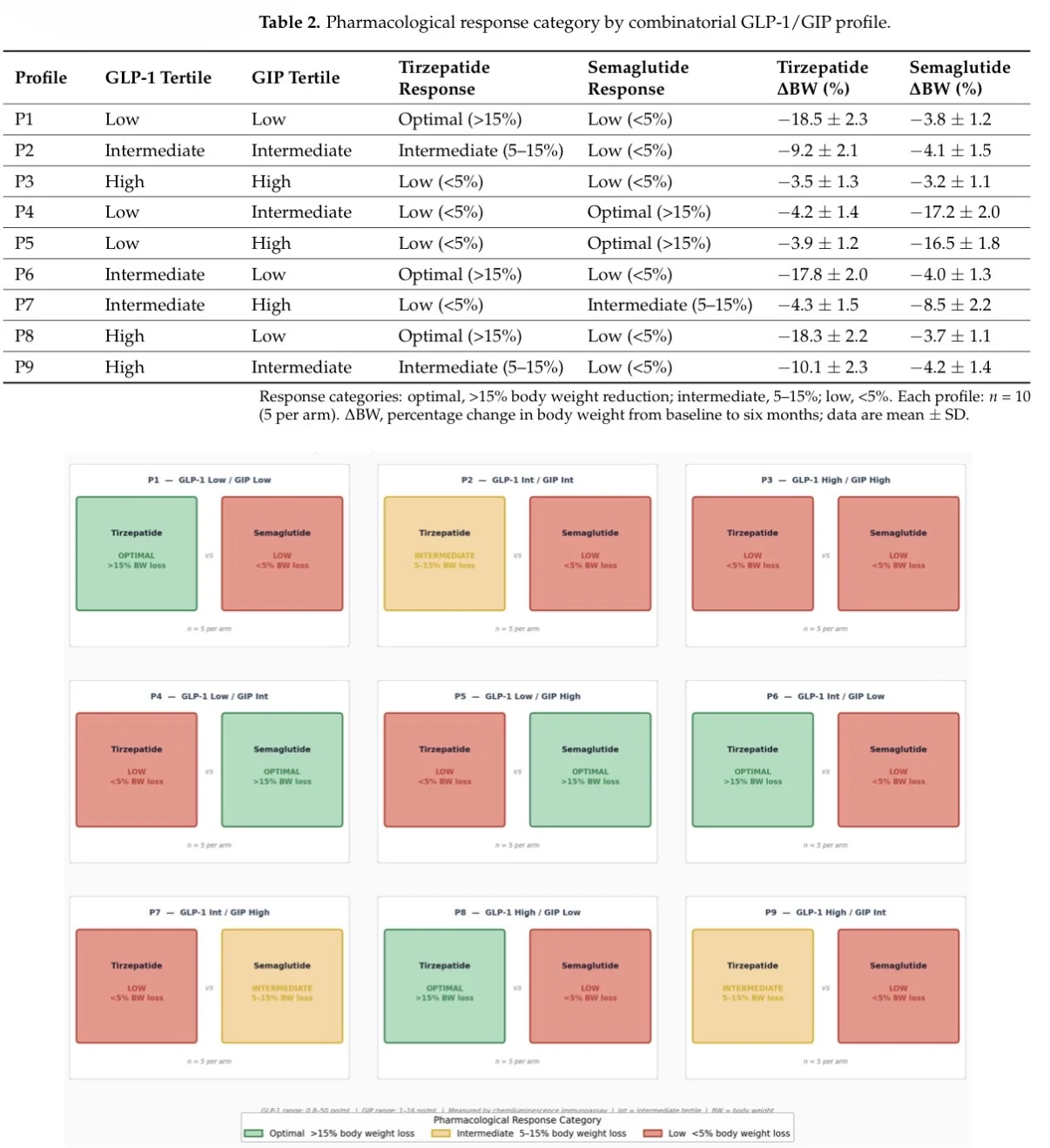
This research examined if fasting GLP-1 and GIP levels at baseline could forecast how well people would respond to semaglutide and tirzepatide, and the results showed they could. One possible explanation is that these medications work better when natural hormone levels are low, which could mean the receptors are more sensitive, while high natural hormone levels might lead to a poorer response because of reduced receptor sensitivity. I expected tirzepatide to beat semaglutide in certain areas, but I didn't expect semaglutide to outperform tirzepatide in others. Yet, upon closer inspection, several other findings are equally unexpected. Tirzepatide outperforming itself in P2 and P9 compared to P4 and P5 is surprising. Tirzepatide achieved its top result in P1, whereas semaglutide had its second poorest. These differences are not small.
 
Semaglutide's effect being largely independent of GIP is logical, and it only appears to perform well when GLP-1 is low. However, the low/low finding is simply puzzling and doesn't add up; some unseen variable outside of these must be responsible for that outcome.

Tirzepatide looks to be independent of GLP-1 and instead more reliant on GIP being low, which seems fairly consistent. Yet the fact that it doesn't also demand low GLP like semaglutide does is difficult to reconcile with its composition. Definitely strange.
 
TL;DR

The takeaway that stands out:

« A pragmatic decision rule—

low GIP → consider tirzepatide;

low GLP-1 with intermediate-high GIP → consider semaglutide;

high GLP-1 + high GIP → consider alternative strategies

—represents a hypothesis-generating framework rather than a clinical recommendation at this stage, and should not be applied in clinical practice until validated in adequately powered, confirmatory multicentre trials. »

For a small sample, the statistical work is handled well, and the authors are upfront about what their findings can and cannot support.

What they found fits with the differing binding affinities at GLP-1R and with tirzepatide's biased agonism.
 
My hunch: Medisan is getting ready to sell an incretin panel for just €80~120 a head, which would spare us from burning €5,000~7,000 on a drug that was never going to work.

Anyone could have called it: low GLP-1 alongside high GIP is the profile that drops pounds fast on sema.

Curious bits worth pulling out of the paper -

4.5. What this means for matching drug to patient#-4-5-implications-for-personalised-obesity-pharmacotherapyEven with the diagnostic ambiguity noted above, the authors argue their results point to a framework that can guide drug choice in personalised obesity care. Nine profile combinations can be boiled down into a handful of practical rules (Figure 3)):

  • GIP in the lowest tertile (GLP-1 does not matter here) → tirzepatide is the better bet (best case: losing more than 15% of body weight)
  • GLP-1 on the low side while GIP sits middling or high → semaglutide is favoured (again, expect better than 15% loss)
  • Both GLP-1 and GIP running high → neither drug does much here (<5% loss), so other routes deserve thought: combined drug therapy, bariatric surgery, or experimental agents aimed at non-incretin pathways
  • Anything else → response is middling or unpredictable, so the choice leans on cost, tolerability and patient preference
The whole thing needs one fasting blood draw and two assays that are already sold commercially, so it can slot into ordinary clinical practice [69]. Paying roughly €80–120 per patient for the two GLP-1 and GIP assays is a rounding error next to six months of semaglutide or tirzepatide (about €5000–7000 in most of Europe), and calling the right drug up front could shorten the road to an effective dose and spare the people predicted not to respond a pointless course [70].

Conflicts of Interest#-conflicts-of-interestOne author, Cristian Fioriglio, works for MEDISAN. Everyone else states that no commercial or financial ties could be read as a competing interest.
 
To me, this seems to be the case for the majority of peptides. Typically, roughly 1/3 of users report great results, another 1/3 describe a modest or slight effect, and the remaining 1/3 notice nothing at all. In my view, that split isn't caused by the peptide itself—it comes down to individual biology. When someone's baseline is low in the pathway a peptide targets, the impact tends to be strong; when that baseline is already high, the peptide does little or nothing. I suspect this also helps explain why studying these compounds and demonstrating their effectiveness is so difficult. Getting real answers would likely require beginning with a solid genetic profile and then comparing individuals who share similar baseline levels.
 
5byfive said:

To me, this seems to be the case for the majority of peptides. Typically, roughly 1/3 of users report great results, another 1/3 describe a modest or slight effect, and the remaining 1/3 notice nothing at all. In my view, that split isn't caused by the peptide itself—it comes down to individual biology. When someone's baseline is low in the pathway a peptide targets, the impact tends to be strong; when that baseline is already high, the peptide does little or nothing. I suspect this also helps explain why studying these compounds and demonstrating their effectiveness is so difficult. Getting real answers would likely require beginning with a solid genetic profile and then comparing individuals who share similar baseline levels.

For a number of mutations, differing affinities toward the three Reta receptors have been documented.

Certain variants stand out, for instance: « R196 Y diminished retatrutide potency by 107.7-fold »

(https://www.nature.com/articles/s41421-024-00700-0)
 
This research is interesting. Should other researchers confirm these findings, measuring GLP and GIP levels before treatment could guide the choice of whether to start these drugs.
 
BrightCandle said:

Semaglutide's effect being largely independent of GIP is logical, and it only appears to perform well when GLP-1 is low. However, the low/low finding is simply puzzling and doesn't add up; some unseen variable outside of these must be responsible for that outcome.

Tirzepatide looks to be independent of GLP-1 and instead more reliant on GIP being low, which seems fairly consistent. Yet the fact that it doesn't also demand low GLP like semaglutide does is difficult to reconcile with its composition. Definitely strange.

Regarding the low/low outcome, my own highly speculative interpretation is that GLP-1 monotherapy is not truly independent of GIP—rather, it may need working GIP levels in order to work. This idea might tie into preclinical research I came across previously, which hints that in certain brain regions GIP boosts the sensitivity of the GLP-1 receptor. When both are low, you would need to address both, since correcting the GIP side is permissive for effectively hitting GLP-1.
 
Back
Top