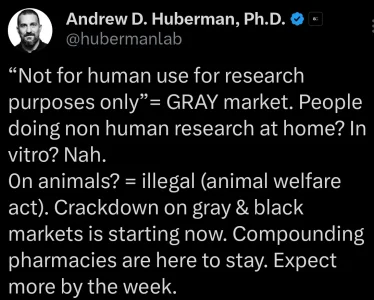

The comparison I keep coming back to is Napster and music sharing versus the RIAA.
Free music downloads never fully disappeared — provided you're ready to do the digging and locate whatever the underground equivalent is to the companies that sell music. It simply sits further out of sight and takes a handful of additional moves compared with opening Napster and entering a track title. Even so, these days the majority of listeners simply hand over money for their music, be it a subscription, iTunes, or some other route, since the price isn't high and the initial process is far less confusing. With enough paying customers, the RIAA stopped actively chasing the leftover underground sharing channels. Keep in mind that at one stage the RIAA was slapping individual people across the country with lawsuits in bulk and pressuring them into settlement payments, all to scare people away from sharing music.
In the same way, the black or gray peptide market isn't going anywhere entirely, but my guess is that far more pressure gets directed at pushing it deep underground. Most ordinary folks are completely fine dropping a dollar or 2 on a track they enjoy, yet when a weight loss subscription runs into the hundreds of dollars each month, that price is steep enough that the same ordinary folks will gladly do a lot more legwork hunting down other suppliers. What an actual crackdown looks like, I can't say, but one thing I'm certain of: it will be chased relentlessly until the industry feels it has locked up no less than 80% of the market by any ethical — or possibly unethical — route available to it.
Free music downloads never fully disappeared — provided you're ready to do the digging and locate whatever the underground equivalent is to the companies that sell music. It simply sits further out of sight and takes a handful of additional moves compared with opening Napster and entering a track title. Even so, these days the majority of listeners simply hand over money for their music, be it a subscription, iTunes, or some other route, since the price isn't high and the initial process is far less confusing. With enough paying customers, the RIAA stopped actively chasing the leftover underground sharing channels. Keep in mind that at one stage the RIAA was slapping individual people across the country with lawsuits in bulk and pressuring them into settlement payments, all to scare people away from sharing music.
In the same way, the black or gray peptide market isn't going anywhere entirely, but my guess is that far more pressure gets directed at pushing it deep underground. Most ordinary folks are completely fine dropping a dollar or 2 on a track they enjoy, yet when a weight loss subscription runs into the hundreds of dollars each month, that price is steep enough that the same ordinary folks will gladly do a lot more legwork hunting down other suppliers. What an actual crackdown looks like, I can't say, but one thing I'm certain of: it will be chased relentlessly until the industry feels it has locked up no less than 80% of the market by any ethical — or possibly unethical — route available to it.