IronPaw. said:
RoadRash said:
IronPaw. said:
CNCCurrency said:
lessthanhalf said:
Sharing that kind of information seems worthwhile to me. My own data matched it exactly, so I'd guess it came from the same place. On here, and even more so on meso, what I've noticed is that most people carry a mistaken picture of what normal levels look like. Based on what they report using, and above all on what bodybuilders are able to use, it becomes very easy to walk away thinking that 4iu a day and above isn't a high dose. For younger people, 2iu or less at least sits nearer to physiological, yet the truth is nobody actually knows the long-term consequences of hgh use, particularly among older users taking it for visceral fat reduction or to hold onto muscle mass, which looks like the most common reason here. The long-term studies simply don't exist, only a handful of short-term ones plus animal work. Declining gh is quite typical as people age, and even more so with obesity, but it matters to keep in mind that no medical recommendations support using it in those situations, since the risks are believed to outweigh the benefits. It wouldn't shock me if wellness clinics and celebrity doctors were using it, but that doesn't make it safe.
Secretagogues may be somewhat safer, since they don't push levels up as far as hgh does, but there's still no evidence of long-term safety. Short-term gains in things like visceral fat, lipids or body composition have turned up in studies of tesamorelin in HIV patients, yet with so many animal studies linking gh deficiency to better life expectancy, you genuinely need long-term safety data to have any real sense of long-term safety, and that probably won't materialize, because Doctors generally view it as a bad safety bet, which makes long-term studies hard to justify.
I'm being a bit of a hypocrite here, since I take 1.5iu/day (igf-1 hasn't been checked yet, though I intend to). My assumption is that 15mg tirz plus 5mg of reta ought to be enough to keep blood glucose from rising, but that will be checked too. My reasoning: given the high overall health risks I carry, and that if I put back some or all of the 54% weight I've lost, my odds of another 10 years of reasonable health drop toward zero (not a common risk profile), the possible small extra risks from hgh are probably smaller than the benefit I get from helping keep weight/fat off. Probably unprovable logic, but it makes sense to me. That logic won't apply to the vast majority of people on this forum, who sit at more normal risk levels, where the risks of hgh or secretagogues, or ghrelin agonists, are very likely greater than the benefits or are simply unknown.
I want to stop people from ending up with things like bigger hearts. If you listen to certain individuals here who can't even do iu to mg conversion, then what they tell you is simply unsafe!!
I'd really value some reliable guidance about dosing so I can avoid ending up with an enlarged heart. Someone told me that 3-5IU per day is fine?
My approach so far has been to ramp up gradually, and I'm now at 2IU taken twice daily — one dose right before bed after a 2hr fast, and the other at 4:30am as soon as I wake, then I keep fasting until 10am.
My goals are fat loss and better sleep. Would .45IU twice a day be sufficient for those results while staying safe?
3iu. 5iu would be overdoing it.
I've cut it down to 1.2IU twice daily—is that still too much?
Initial dosage:
• Under 30 years of age:
1.2 – 1.5 IU daily (0.4 – 0.5 mg/day) (higher amounts may be needed by those moving off pediatric care)
• Between 30 and 60 years of age:
0.6 – 0.9 IU daily (0.2 – 0.3 mg/day)
• Beyond 60 years of age:
0.3 -0.6 IU daily (0.1-0.2 mg/day)
Anyone with diabetes, or who tends toward insulin resistance / glucose intolerance, ought to begin at the smallest dose (0.3 -0.6 IU daily) no matter their age.
Injections under the skin are typically given at night so they copy the body's natural overnight GH release.
Raising the dose (titration):
Every 1 to 2 months, add 0.3 -0.6 IU daily (0.1-0.2 mg/day), guided by how the patient responds clinically, blood IGF-1 readings, adverse effects, and personal factors like insulin resistance / glucose intolerance.
For older patients, longer gaps between increases and smaller steps up may be required.
What GH treatment is aiming for:
Target blood IGF-I values in the mid part of the normal range for the person's age and sex, unless adverse effects are pronounced. A trial of larger GH doses can be considered to see whether extra benefit appears, provided serum IGF-I stays inside the normal range and no adverse effects occur.
Tracking:
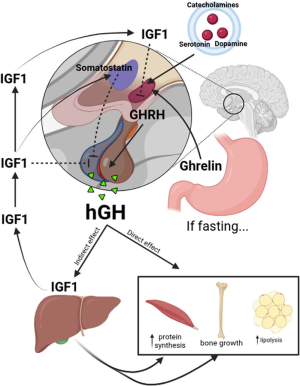
Although IGF-1 readings do not reliably reflect GH status, using IGF-1 to follow treatment of adult GH disorders is now broadly endorsed, particularly since GH-dosing approaches for growth hormone deficiency shifted from weight-based dosing (linked to overtreatment and adverse effects) toward individualized dose-titration methods that hold IGF1 inside target limits.[7]
Every 6 months once maintenance doses are reached. Tracking ought to cover clinical assessment and review of adverse effects, blood IGF-1, fasting blood glucose, and T3, T4 and free T4, along with a lipid profile. Quality of life measures might be taken every 6 or 12 months.
Those receiving thyroid, sex hormone or glucocorticoid treatment at the same time may require dose changes once GH replacement begins.
Things that can make larger GH doses necessary:
• Younger patients, whatever the onset type
• Low blood IGF-1 readings
• Starting oral estrogen
• Switching from transdermal to oral estrogen
• Breaking down stored body fat (lipolysis)
Things that can make smaller GH doses necessary:
• Older patients
• High blood IGF-1 readings
• Stopping oral estrogen
• Switching from oral to transdermal estrogen
• Being treated with testosterone at the same time
• Rising fasting blood glucose and/or HbA1c (i.e. worsening glucose tolerance)