
Back in the gym on Reta — is this normal?

ZetsuM

Explorer
Joined
Jun 8, 2026
Messages
69
Reaction score
0
Location
Belgium
So yesterday I made it back to the gym.

It had been a while. Running is something I picked up again roughly two weeks back, and that's gone reasonably well so far. Yesterday felt like the moment to light that fire again.

My last proper training session was over a year ago — almost 2 — so I'm expecting it to take a while to find my feet.

What stood out was the calorie deficit, if that makes sense. I kept pushing, yet roughly 30 minutes in I had nothing left.

Today my back is aching after nothing more than 3 sets of 10 on the seated row and lat pulldown. Some lateral raises for the shoulders went in too.

The burn was unmistakable, and I could feel the lactic acid pooling in the muscles.

Anyone else hit this wall coming back after a long layoff? Do I simply grind through it, without courting injury, or is diet the lever I should be pulling?

Protein is covered, electrolytes are going in, and I'm drinking at least 2 liters of water daily.

Adjustments are on the table, though I'd rather not stall the weight loss.

There's a body composition scale at my gym. Accuracy is anyone's guess, but it put me at 87.2 kg and 25% body fat. I began at 95 kg (body fat unknown), so the direction of travel pleases me.

Appreciate any input!
 
After that long away from training, feeling weak is entirely expected. Being in a deficit while also returning to the gym would explain it. My advice is to train consistently for at least 2 weeks before changing anything drastic in your regiment. The one thing I'd genuinely suggest right now is nudging your daily carbs up, or at minimum loading more carbs an hour or 2 ahead of a session.

Deficits drain me fast as well. It shows up even more when I've slept poorly the night before. Happens to the best of us 👍.
 
aepower2016 said:

After that long away from training, feeling weak is entirely expected. Being in a deficit while also returning to the gym would explain it. My advice is to train consistently for at least 2 weeks before changing anything drastic in your regiment. The one thing I'd genuinely suggest right now is nudging your daily carbs up, or at minimum loading more carbs an hour or 2 ahead of a session.

Deficits drain me fast as well. It shows up even more when I've slept poorly the night before. Happens to the best of us 👍.
Thanks — habit has me taking a spoonful of raw honey on my way out the door, whether it's the gym or a run.

Pre-workout is something I'm avoiding, since a big caffeine hit and reta don't sit well together.
 
Broadly speaking, anyone lifting on a GLP-1 while running a deep calorie deficit needs to reset their expectations. Building strength and adding muscle under those conditions is genuinely hard. A complete novice chasing noob gains might manage it, but for nearly everyone the actual aim is holding on to the muscle you have and telling your body not to burn it before the fat. Your situation doubles down on that, since you're coming back to lifting after time away while not really being new to it.

Six months in and I'm 41 pounds lighter, training heavy and consistently throughout, with noticeably better definition — yet my main lifts have barely moved, and my 1RM has actually slipped in a few. Annoying, in a way, though the fat loss leaves me looking more muscular than I did before, and I'm confident strength comes back once I reach maintenance and switch to recomp.
 
Soreness comes in 2 flavours. 1. The kind where the muscles simply aren't accustomed to the overload any more. 2. The kind that feels like something is wrong, or on the verge of giving out. Believe me, you and your body can tell which is which.

If it's #1, then grinding through is the answer. That doesn't mean going all out daily, just letting your body acclimatise to tension again. Go lighter for a few days. Taking constant breaks teaches your body and mind that a break is always due, and that habit is usually one of the reasons people stall on their weightloss journey.
 
My own restart left me sore for several days — DOMS rather than pain, but strong. Push through it. The following week felt easier and every lift went up. Come week three the soreness was minor and my sessions could run twice as long. The main thing I'd advise is staying active on rest days so blood keeps moving. A walk of at least 2 miles is my floor, since circulation speeds repair along.
 
ZetsuM said:

So yesterday I made it back to the gym.

It had been a while. Running is something I picked up again roughly two weeks back, and that's gone reasonably well so far. Yesterday felt like the moment to light that fire again.

My last proper training session was over a year ago — almost 2 — so I'm expecting it to take a while to find my feet.

What stood out was the calorie deficit, if that makes sense. I kept pushing, yet roughly 30 minutes in I had nothing left.

Today my back is aching after nothing more than 3 sets of 10 on the seated row and lat pulldown. Some lateral raises for the shoulders went in too.

The burn was unmistakable, and I could feel the lactic acid pooling in the muscles.

Anyone else hit this wall coming back after a long layoff? Do I simply grind through it, without courting injury, or is diet the lever I should be pulling?

Protein is covered, electrolytes are going in, and I'm drinking at least 2 liters of water daily.

Adjustments are on the table, though I'd rather not stall the weight loss.

There's a body composition scale at my gym. Accuracy is anyone's guess, but it put me at 87.2 kg and 25% body fat. I began at 95 kg (body fat unknown), so the direction of travel pleases me.

Appreciate any input!
More water is what I'd recommend. A single workout of mine accounts for 1 liter, and that's 21 sets plus 1 hour of cardio. Nobody ever got fat from water, so raise that intake for sure. There's definitely a curve to getting back into the gym. Be patient and try to add a little more each time.
 
If training has been off the cards for a while, rushing at it hard is the wrong move. Fainting at the gym is a real risk. On Reta, strength work is a marathon rather than a sprint.

Begin light: a load that lets you manage roughly 10-12 reps across 3 sets, or whatever suits your goal. Cardio is the same story — stationary cycling, stairmaster, incline walking, elliptical, swimming, take your pick.

Keep the difficulty up, but don't overdo it given the calorie deficit — nor drop it so low that hitting your target reps becomes effortless.

Hydration as ever. Water in quantity, plus electrolytes. Stay safe!
 
ZetsuM said:

So yesterday I made it back to the gym.

It had been a while. Running is something I picked up again roughly two weeks back, and that's gone reasonably well so far. Yesterday felt like the moment to light that fire again.

My last proper training session was over a year ago — almost 2 — so I'm expecting it to take a while to find my feet.

What stood out was the calorie deficit, if that makes sense. I kept pushing, yet roughly 30 minutes in I had nothing left.

Today my back is aching after nothing more than 3 sets of 10 on the seated row and lat pulldown. Some lateral raises for the shoulders went in too.

The burn was unmistakable, and I could feel the lactic acid pooling in the muscles.

Anyone else hit this wall coming back after a long layoff? Do I simply grind through it, without courting injury, or is diet the lever I should be pulling?

Protein is covered, electrolytes are going in, and I'm drinking at least 2 liters of water daily.

Adjustments are on the table, though I'd rather not stall the weight loss.

There's a body composition scale at my gym. Accuracy is anyone's guess, but it put me at 87.2 kg and 25% body fat. I began at 95 kg (body fat unknown), so the direction of travel pleases me.

Appreciate any input!
You're doing the right thing getting back into it… Lifting is still new to me, and rule one is simply: don't get hurt (I'm old and feeble). If cutting volume — fewer reps per set, lighter weight, or both — is what it takes, then do that. Far wiser than an injury you could have avoided by going five pounds, or ten pounds, lighter… what's that extra weight really worth if it puts you out of training until you heal?
 
fatjacked said:

Broadly speaking, anyone lifting on a GLP-1 while running a deep calorie deficit needs to reset their expectations. Building strength and adding muscle under those conditions is genuinely hard. A complete novice chasing noob gains might manage it, but for nearly everyone the actual aim is holding on to the muscle you have and telling your body not to burn it before the fat. Your situation doubles down on that, since you're coming back to lifting after time away while not really being new to it.

Six months in and I'm 41 pounds lighter, training heavy and consistently throughout, with noticeably better definition — yet my main lifts have barely moved, and my 1RM has actually slipped in a few. Annoying, in a way, though the fat loss leaves me looking more muscular than I did before, and I'm confident strength comes back once I reach maintenance and switch to recomp.
Lifting isn't new territory for me.

A professional coach used to train me.

Getting somewhat leaner matters, but I also want functional strength back so I can play the sports I used to. There's another issue: on Reta the weight loss stalled after 7.5 kg (87.5 has been my number for 2 weeks now).

So my thinking was that training would sort it, more muscle meaning more kcals burned.
 
TacoLifter420 said:

Just ease in gradually. Improvement comes with time.

Lifting is a long haul, not a dash.
Yeah, waiting around has never been my strong suit, unfortunately. 😒
 
ZetsuM said:

So yesterday I made it back to the gym.

It had been a while. Running is something I picked up again roughly two weeks back, and that's gone reasonably well so far. Yesterday felt like the moment to light that fire again.

My last proper training session was over a year ago — almost 2 — so I'm expecting it to take a while to find my feet.

What stood out was the calorie deficit, if that makes sense. I kept pushing, yet roughly 30 minutes in I had nothing left.

Today my back is aching after nothing more than 3 sets of 10 on the seated row and lat pulldown. Some lateral raises for the shoulders went in too.

The burn was unmistakable, and I could feel the lactic acid pooling in the muscles.

Anyone else hit this wall coming back after a long layoff? Do I simply grind through it, without courting injury, or is diet the lever I should be pulling?

Protein is covered, electrolytes are going in, and I'm drinking at least 2 liters of water daily.

Adjustments are on the table, though I'd rather not stall the weight loss.

There's a body composition scale at my gym. Accuracy is anyone's guess, but it put me at 87.2 kg and 25% body fat. I began at 95 kg (body fat unknown), so the direction of travel pleases me.

Appreciate any input!
Think of someone coming out of a 3 month coma: regaining walking fitness takes a painstakingly slow course of physical therapy. Muscles left without meaningful exercise will have wasted away, and ignoring what your body is telling you risks an injury that sets your whole return to activity back badly. Move slower than feels necessary, and within a few weeks a more effective pace becomes available.

One more thing: eat carbs 2-3 hours ahead of a session if you aren't already. Protein digests slowly, so it serves recovery better than it serves fuelling the work itself.
 
kartikeya said:

ZetsuM said:

So yesterday I made it back to the gym.

It had been a while. Running is something I picked up again roughly two weeks back, and that's gone reasonably well so far. Yesterday felt like the moment to light that fire again.

My last proper training session was over a year ago — almost 2 — so I'm expecting it to take a while to find my feet.

What stood out was the calorie deficit, if that makes sense. I kept pushing, yet roughly 30 minutes in I had nothing left.

Today my back is aching after nothing more than 3 sets of 10 on the seated row and lat pulldown. Some lateral raises for the shoulders went in too.

The burn was unmistakable, and I could feel the lactic acid pooling in the muscles.

Anyone else hit this wall coming back after a long layoff? Do I simply grind through it, without courting injury, or is diet the lever I should be pulling?

Protein is covered, electrolytes are going in, and I'm drinking at least 2 liters of water daily.

Adjustments are on the table, though I'd rather not stall the weight loss.

There's a body composition scale at my gym. Accuracy is anyone's guess, but it put me at 87.2 kg and 25% body fat. I began at 95 kg (body fat unknown), so the direction of travel pleases me.

Appreciate any input!
Think of someone coming out of a 3 month coma: regaining walking fitness takes a painstakingly slow course of physical therapy. Muscles left without meaningful exercise will have wasted away, and ignoring what your body is telling you risks an injury that sets your whole return to activity back badly. Move slower than feels necessary, and within a few weeks a more effective pace becomes available.

One more thing: eat carbs 2-3 hours ahead of a session if you aren't already. Protein digests slowly, so it serves recovery better than it serves fuelling the work itself.
Shoulders remain sore, the back slightly less so.

Some carbs do go in, though nowhere near a full meal's worth. A banana at most, that kind of thing.

Which is exactly what I was getting at with how the caloric deficit felt.
 
Aim for roughly 60-70% effort across the opening weeks, or you'll be in a world of pain with brutal DOMS, unable to sit on the toilet properly or get out of bed 🤣 Muscle memory does the rest once it kicks in.
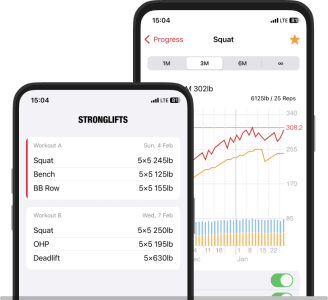
For myself, after any decent break I like to run Strong Lifts 5x5 — a range of compound lifts, starting light and adding weight each session. Straightforward to follow too.


57b3d3b245c30dc18ea78eb684f5ae5595a0df1cfe4d73f163765176596a176e.png


Stronglifts 5×5: The Complete Workout Guide [2026] | Stronglifts


The best 5×5 workout guide on the entire Internet. Discover how to build strength and muscle doing only three full body workouts per week.

f5dcb1b0ed9373913552924e02a01b9684da33b75958f0153d086dc0a4036ed0.png


stronglifts.com
 
px1984 said:

Aim for roughly 60-70% effort across the opening weeks, or you'll be in a world of pain with brutal DOMS, unable to sit on the toilet properly or get out of bed 🤣 Muscle memory does the rest once it kicks in.

For myself, after any decent break I like to run Strong Lifts 5x5 — a range of compound lifts, starting light and adding weight each session. Straightforward to follow too.


View attachment 110


Stronglifts 5×5: The Complete Workout Guide [2026] | Stronglifts


The best 5×5 workout guide on the entire Internet. Discover how to build strength and muscle doing only three full body workouts per week.

View attachment 111


stronglifts.com
Thanks — I'll take a look and give it a go. Those starting weights do look tiny, though I suppose that's the price of such a long layoff. 😆
 

Attachments

  • 57b3d3b245c30dc18ea78eb684f5ae5595a0df1cfe4d73f163765176596a176e.png
    57b3d3b245c30dc18ea78eb684f5ae5595a0df1cfe4d73f163765176596a176e.png
    18.7 KB · Views: 32
  • f5dcb1b0ed9373913552924e02a01b9684da33b75958f0153d086dc0a4036ed0.png
    f5dcb1b0ed9373913552924e02a01b9684da33b75958f0153d086dc0a4036ed0.png
    1.5 KB · Views: 36
ZetsuM said:

px1984 said:

Aim for roughly 60-70% effort across the opening weeks, or you'll be in a world of pain with brutal DOMS, unable to sit on the toilet properly or get out of bed 🤣 Muscle memory does the rest once it kicks in.

For myself, after any decent break I like to run Strong Lifts 5x5 — a range of compound lifts, starting light and adding weight each session. Straightforward to follow too.


View attachment 110


Stronglifts 5×5: The Complete Workout Guide [2026] | Stronglifts


The best 5×5 workout guide on the entire Internet. Discover how to build strength and muscle doing only three full body workouts per week.

View attachment 111


stronglifts.com
Thanks — I'll take a look and give it a go. Those starting weights do look tiny, though I suppose that's the price of such a long layoff. 😆
My own approach is to pick a load you can handle 10-12 comfortable reps with, then nudge it by 2.5kg every session — it stacks up fast!
 
px1984 said:

ZetsuM said:

px1984 said:

Aim for roughly 60-70% effort across the opening weeks, or you'll be in a world of pain with brutal DOMS, unable to sit on the toilet properly or get out of bed 🤣 Muscle memory does the rest once it kicks in.

For myself, after any decent break I like to run Strong Lifts 5x5 — a range of compound lifts, starting light and adding weight each session. Straightforward to follow too.


View attachment 110


Stronglifts 5×5: The Complete Workout Guide [2026] | Stronglifts


The best 5×5 workout guide on the entire Internet. Discover how to build strength and muscle doing only three full body workouts per week.

View attachment 111


stronglifts.com
Thanks — I'll take a look and give it a go. Those starting weights do look tiny, though I suppose that's the price of such a long layoff. 😆
My own approach is to pick a load you can handle 10-12 comfortable reps with, then nudge it by 2.5kg every session — it stacks up fast!
Yeah, fair. Deadlifts used to be a strength of mine, so I might push that up a touch and see where it lands me. A solid place to begin, no question!
 
After any layoff, this is the pattern that has always served me (patience required lol)...

For the first several weeks, most movements (presses, rows, that sort of thing) get only 2 working sets, while back squats or dead lifts get just 1. Accessories are largely skipped. Sure, at the start you're finished in 15 or 20 minutes.

Once several weeks have passed, bring in 3 working sets on presses and pulls, and 2 working sets on squats and deadlifts. When you're ready, add the 3rd set of squats and deadlifts.

That is the only way I can be sure of not aggravating something and ending up sidelined right after starting, which matters all the more on a calorie deficit. My hamstrings tweak easily, hence the slow progression on squats and deadlift.
 
Back
Top