
Super Trips
Explorer
CBL-514 is an investigational injectable medication that could prove both safe and effective when it comes to trimming stubborn fat deposits under the skin of the abdomen.

Follow along with the video below to see how to install our site as a web app on your home screen.
Note: This feature may not be available in some browsers.
I'd really like to see some articles or links on this. Yeah, I'm aware Google is a thing, but what I'm more interested in is what you've personally come across, rather than Google's chilly robot-brain algorithm, haha.Super Trips said:
CBL-514 is an investigational injectable medication that could prove both safe and effective when it comes to trimming stubborn fat deposits under the skin of the abdomen.
Super Trips said:
CBL-514 is an investigational injectable medication that could prove both safe and effective when it comes to trimming stubborn fat deposits under the skin of the abdomen.

Mr. Blonde said:
Can you actually purchase CBL-514 at this point? To be clear, I'm talking about the grey market, not the big pharma version.
"It is a proprietary small-molecule drug currently in Phase 3 clinical trials and owned exclusively by Caliway Biopharmaceuticals, a publicly traded company based in Taiwan (TWSE: 6919)"Mr. Blonde said:
Can you actually purchase CBL-514 at this point? To be clear, I'm talking about the grey market, not the big pharma version.


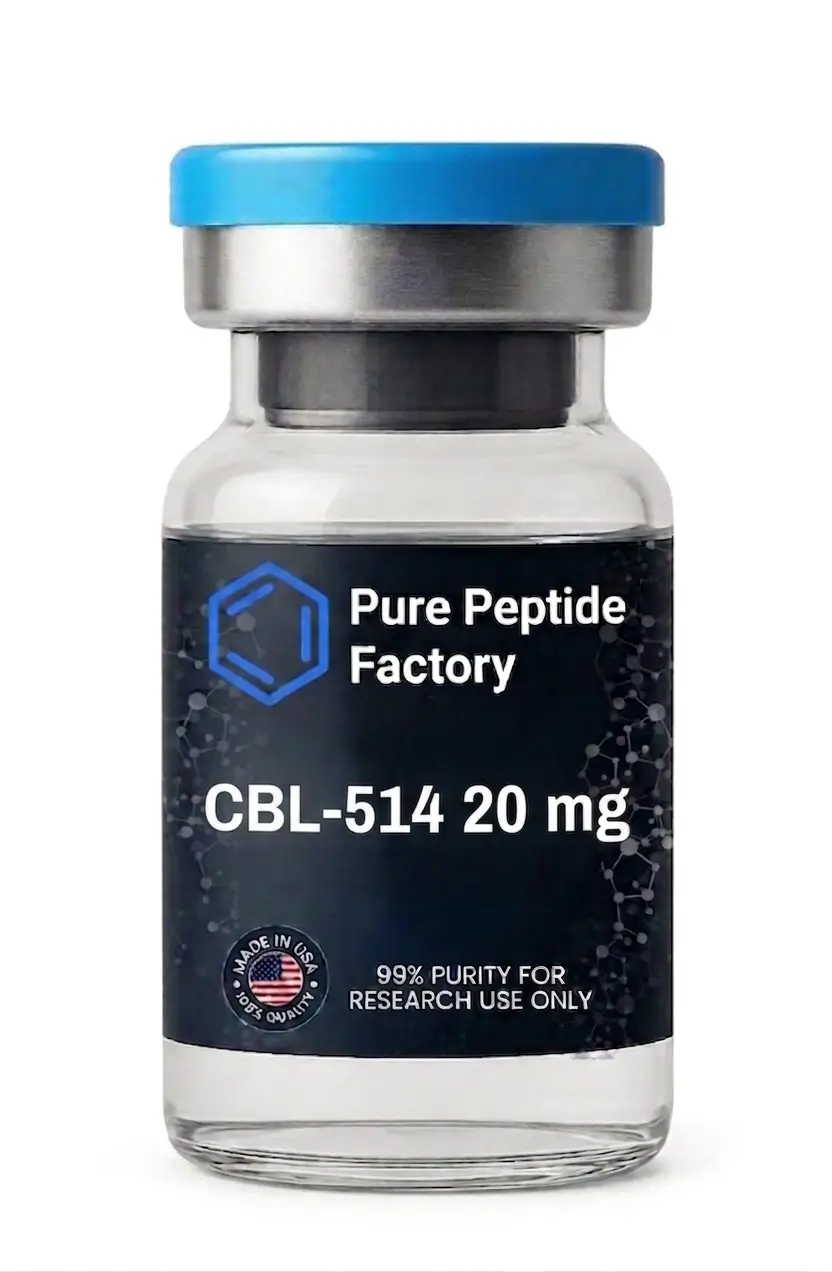
 purepeptidefactory.com
Not sure those vial sizes are going to be enough lol:Symmetry said:
CBL-514 20 mg
CBL 514, research-grade adipocyte apoptosis inducer targeting the RIPK1/RIPK3/MLKL necroptosis pathway. For body contouring, lipoma, and adipose tissue research. Domestic cold-chain shipping, HPLC verified. Research use only.
The participants (BMI 22–30 kg/m2) (age range 36.4 years to 42.4 years) received injections of up to 600 mg of CBL-514 (n=23) or placebo (n=17) into the lower abdomen every three weeks for up to 12 weeks. The exact number of injections depended on the thickness of their abdominal fat.
Click to expand...
Symmetry said:
CBL-514 20 mg
CBL 514, research-grade adipocyte apoptosis inducer targeting the RIPK1/RIPK3/MLKL necroptosis pathway. For body contouring, lipoma, and adipose tissue research. Domestic cold-chain shipping, HPLC verified. Research use only.


 www.vyntabiotech.com
Honestly, that's kind of amusing — the studies dosed 600mg/day while each vial holds only 20mg, meaning you'd need 30 vials, likely quite pricey ones, just to cover a single day's dose.Bird_of_Hermes said:
Not sure those vial sizes are going to be enough lol:
https://medicalxpress.com/news/2026-10-weight-loss-fat-cells-cbl.html

This isn't a GH peptide in any way. It works entirely differently. What it is: a small molecule that instructs fat cells to undergo programmed cell death. Administration is local — think a set of injections spread over the abdomen, for instance.rkbleddyn said:
I only began looking into it once I came across this post. Still, my hunch is that even if it isn't, that situation won't last long. What really grabs my attention is the safety profile, assuming it turns out to be comparable to the peptides in the 'morelin' class.
Is cortisol or prolactin affected by tesa?rkbleddyn said:
What do you mean when you say it's safe? The 3 things that concern me before I'd start Tesa are edema, plus cortisol and prolactin going up.
Once the FDA gets around to banning every peptide, they're really going to have their work cut out for them, because my guess is it'll have to happen compound by compound. A blanket ban covering every compound that exists or was ever synthesized doesn't seem like something they can pull off. At least I hope not. What science needs is thousands, possibly millions, of brand new peptides, each altered just enough in its structure to count as its own compound while producing comparable effects.
All it should take is a handful of tech bro scientists armed with AI to start churning out millions of fresh peptides daily and send those FDA luddites back into their cave.
Producing and distributing CBL-514 won't be a simple task. Building it is far more demanding than putting together a basic short peptide, or even one of medium length. The raw materials themselves aren't hard to get—curcumin and trans-resveratrol can both be sourced without much trouble. The tricky part is the synthesis route that turns those starting materials into the small molecule; it appears quite involved. On top of that, the patent doesn't make it clear whether the compound can be stabilized into a powder form. It's possible that it would need to be shipped as an injectable liquid under tightly controlled conditions. Any vendor claiming to have it in stock today would raise serious doubts for me.BioDad said:
I would need to dig around for the references, so for now you will just have to trust me on this, but the product is reportedly a proprietary blend built mainly around Curcumin and resveratrol (possibly at a 4:1 ratio). No published formula is out there, and that is likely the reason it has not shown up broadly on the grey market. At least 1 animal study hints that it may also do something for visceral and hepatic fat along with certain metabolic parameters. What grabbed my attention the most, though — and again, I would have to dig this up — was 1 animal study indicating that weight regain after GLP-1 was reduced when CBL-514 was used at the same time. So it does appear to work and be fairly safe for subcutaneous fat, while possibly having other uses too.
It is intriguing. Compared with some of the deoxyxcholate-based formulas, it also seems less harsh. After searching a bit, I have not located the exact formula, or anyone producing it, anywhere.


