
Which Blood Work/Lab Tests Do You Recommend?

bluewater

Explorer
Joined
Mar 16, 2026
Messages
43
Reaction score
0
Location
Australia
Hey all,

I'd like some input on which blood panels would give me objective data about how well my current stack is working.

For roughly 3 months now, I've been taking:

  • Retatrutide (5mg per week at present)
  • MOTS-C (10 weeks on / 4 weeks off)
  • SS31 (10 weeks on / 4 weeks off)
In that period I've dropped 16.5kg, my blood pressure has gone down, and I'm not fighting fatigue in the middle of the afternoon anymore. So by any objective read, things are moving the right way.

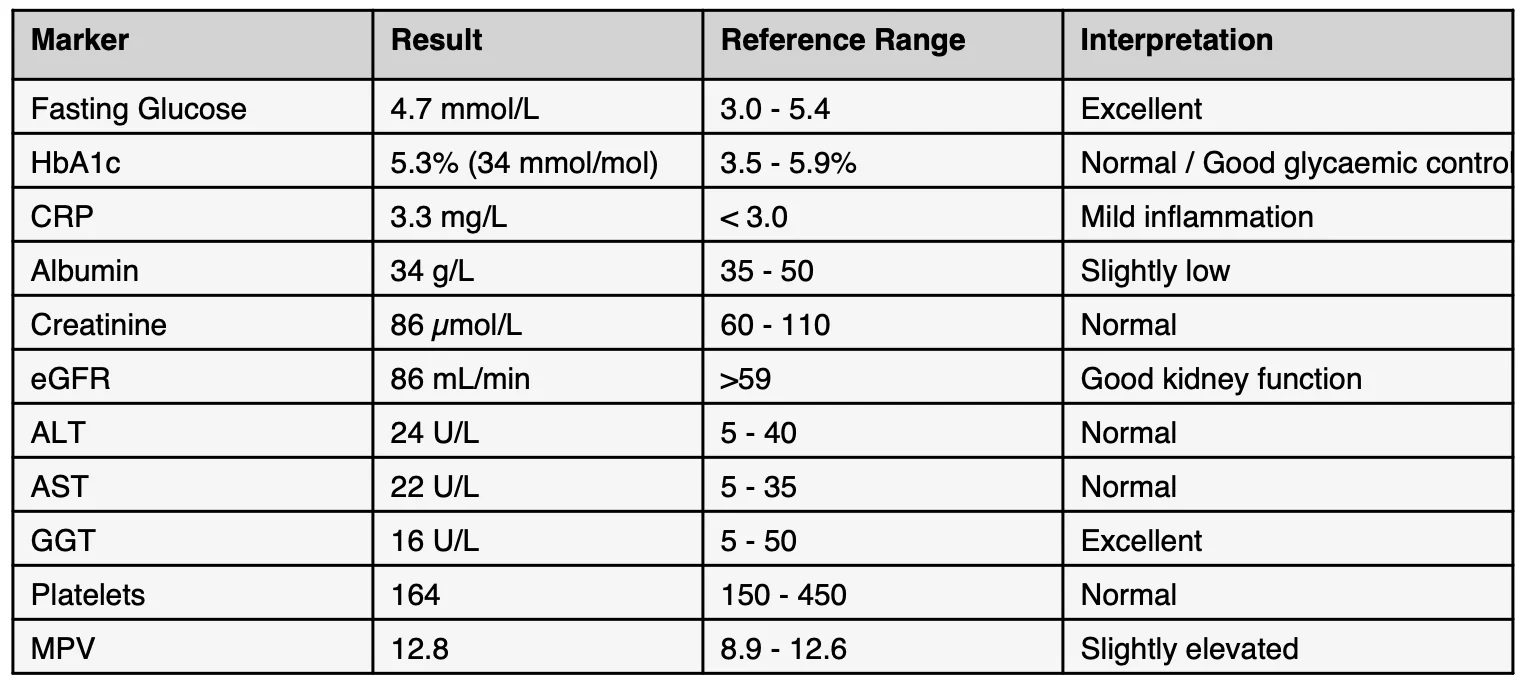
Before I began (3 months back), I had these blood panels run — though this overlapped with me getting over a low grade infection, which might be why CRP came back mildly elevated.

Still, what I really want is guidance on which additional markers I ought to be tracking. Take this example: how would I even tell whether SS31 / MOTS-C is producing a measurable effect on Mitochondrial function / efficiency?

On top of that, I have Stable Angina, so are there other factors or tests I should be lining up? I see my Cardiologist once a year and he's not worried about anything beyond getting the weight off.


733c266e53694aa949efd6e16c4659f61439bfdf308e172084374a09068090e4.webp
 
Trying to assess mitochondrial function through blood tests is quite difficult. Heteroplasmy is the main obstacle here. Within any single cell, the proportion of mutated mitochondria can differ a lot, and how much this affects cellular function depends on which cells are being examined. In the brain, the threshold for mitochondrial dysfunction is very low, whereas muscle tissue can tolerate mutated or oxidized mitochondria to a much greater extent. Given this variability in heteroplasmy, genetic sequencing is the only method that can measure mitochondrial function accurately, and it tends to be rather expensive.
 
Tbagger said:

Trying to assess mitochondrial function through blood tests is quite difficult. Heteroplasmy is the main obstacle here. Within any single cell, the proportion of mutated mitochondria can differ a lot, and how much this affects cellular function depends on which cells are being examined. In the brain, the threshold for mitochondrial dysfunction is very low, whereas muscle tissue can tolerate mutated or oxidized mitochondria to a much greater extent. Given this variability in heteroplasmy, genetic sequencing is the only method that can measure mitochondrial function accurately, and it tends to be rather expensive.
That's really intriguing. Could you point me toward any scientific papers that cover this?
 
eidos said:

Tbagger said:

Trying to assess mitochondrial function through blood tests is quite difficult. Heteroplasmy is the main obstacle here. Within any single cell, the proportion of mutated mitochondria can differ a lot, and how much this affects cellular function depends on which cells are being examined. In the brain, the threshold for mitochondrial dysfunction is very low, whereas muscle tissue can tolerate mutated or oxidized mitochondria to a much greater extent. Given this variability in heteroplasmy, genetic sequencing is the only method that can measure mitochondrial function accurately, and it tends to be rather expensive.
That's really intriguing. Could you point me toward any scientific papers that cover this?
I don't have any with me right now. A quick Google search should turn up some articles, though.
 
Back
Top