
T Levels Fell After Dose Increase — Could the Vial Be Underdosed?

DiRTY DOG

Explorer
Joined
Dec 13, 2025
Messages
13
Reaction score
27
Location
US
My T levels went down after I increased my dose. What's happening? Could my new vial be weaker than it should be?

No AI at all. Every test has been run at the same lab, drawn at the same point at the end of the trough before the next dose, at the same early-morning time, using the same IM injection method — 3 doses per week, split evenly. Nothing differs; I track and time everything carefully. The ONLY change is that I recently began a new vial from a different pharmacy.

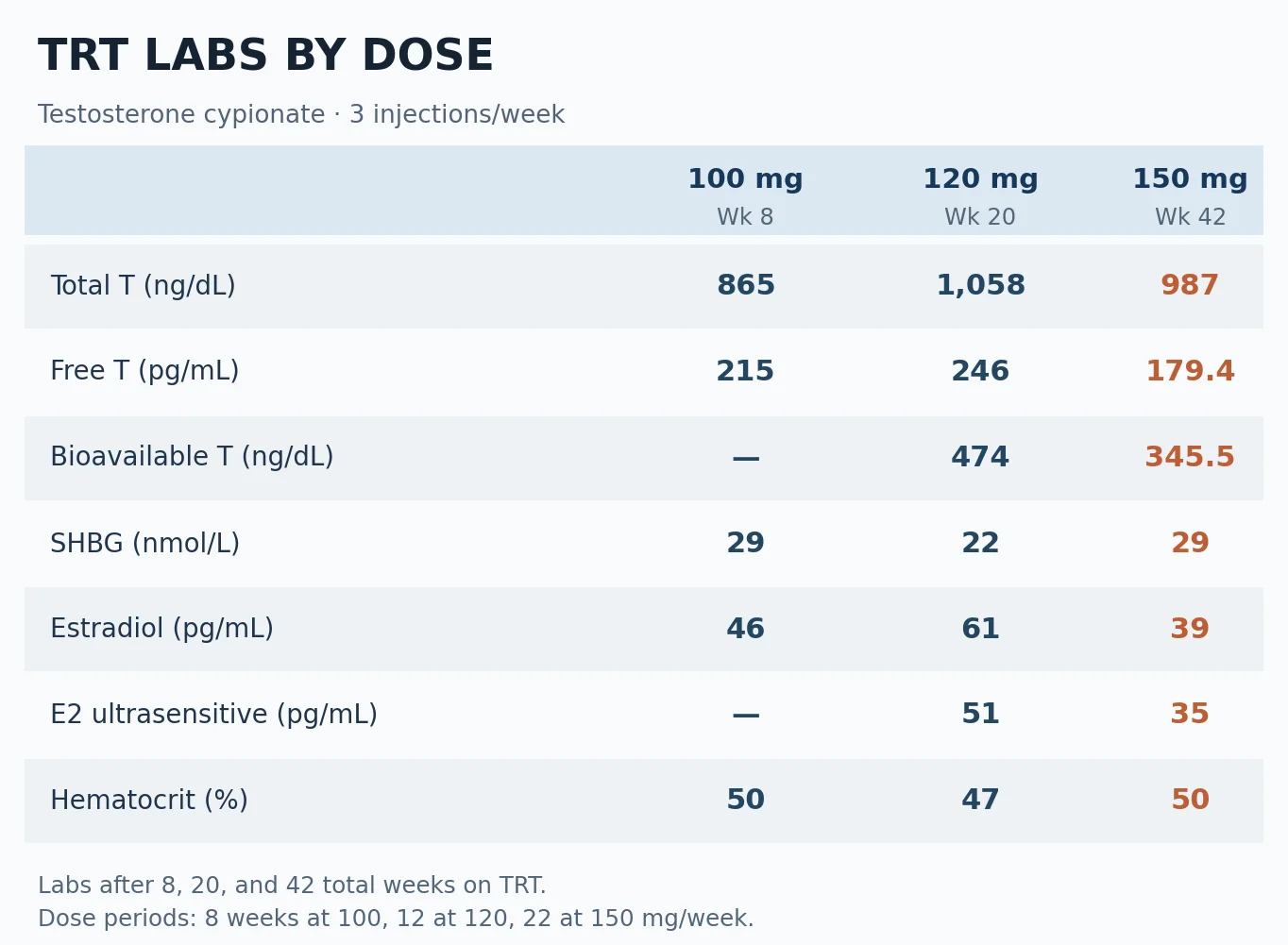
I began TRT Kingdom 10 months ago aiming at hormone optimization. First labs showed Total T 300. The starting dose was 100mg/week divided 3x for 2 months. I responded well, see chart:

Total T: 865

SHBG: 29

Free T: 215

Estrodiol: 46

Hematocrit: 50%

Increased to 120mg/week divided 3x for 3 months and responded well once more.

Total T: 1058

SHBG: 22

Free T: 246

Bioavailable T: 474

Estrodiol: 61

Estrodiol Ultrasensative: 51

Hematocrit: 47%

Increased again to 150mg/week divided 3x for 3 months. Started a new vial from a different pharmacy (Eugia) and stayed at 150mg/week for another 3 months. That makes 6 months total at 150mg. I felt pretty good at this point, low T symptoms largely gone, no estrogen symptoms. Lately I felt I still wasn't optimized and there was room to improve. So I got labs to check where I stood. My levels DROPPED even though the dose was higher than at the previous lab???

Total T: 987

SHBG: 29

Free T: 179.4

Bioavailable T: 345.5

Estrodiol: 39

Estrodiol Ultrasensative: 35

Hematocrit: 50%

What's going on? I gradually lost 20 lbs over this period and put on some muscle from weight lifting. NOTHING else changed. Is the new vial/pharmacy I switched to weak? That seems the easy answer, but is it? Why would all my T numbers fall at a higher dose?

What should I do now?


8db6624ff96d2e5776d1a0044a8f0f2dbaeffb4b1503fcc4c454a3a5e93eb35d.webp
 
A 7% decrease in total T falls within the range of normal lab and day-to-day fluctuation, so pinning that on the vial alone is a stretch, and a pharmacy generic that's underdosed is quite uncommon. The larger drop in free and bioavailable T tends to suggest SHBG is rising, which happens often after losing 20 lbs, so before drawing conclusions, look at what your SHBG read on the 120mg panel. It's worth repeating the panel in 6 to 8 weeks with the same trough timing, and keep your prescriber in the loop about that 50% hematocrit, mate.
 
Are you getting labs drawn while fasted?

Below are several factors that may explain a sudden drop (via Google)

Consuming certain foods or drinks shortly before a testosterone blood draw—particularly sugary foods/drinks, large or high-carb meals, and alcohol—may temporarily reduce measured testosterone levels. [1, 2]

  • Sugary foods and refined carbs: A glucose load or sugar intake can produce a short-lived decrease in serum testosterone within 1 to 2 hours. A sugary breakfast or drink consumed just before a lab draw may make your levels appear lower than your baseline. [1, 2]
    • Meals right before testing: A meal consumed before blood collection (high-sugar or mixed meals in particular) can transiently reduce total testosterone and make results harder to interpret consistently. Standard evaluations commonly rely on morning fasted testing. [1, 2]
    • Alcohol: Heavy drinking the previous night may lower testosterone levels, so staying away from alcohol for at least 24 hours before testing helps avoid short-term disruption.
    • Foods with weaker or longer-term evidence: Things such as licorice root, mint/spearmint, flaxseed, and ultra-processed foods / trans fats come up often in hormone discussions, though most of the evidence reflects habitual intake, animal/small studies, or indirect effects rather than guaranteed immediate drops from a single pre-test serving. [1, [2, [3, [4, [5, [6]
 
Skidude said:

Are you getting labs drawn while fasted?

Below are several factors that may explain a sudden drop (via Google)

Consuming certain foods or drinks shortly before a testosterone blood draw—particularly sugary foods/drinks, large or high-carb meals, and alcohol—may temporarily reduce measured testosterone levels. [1, 2]

  • Sugary foods and refined carbs: A glucose load or sugar intake can produce a short-lived decrease in serum testosterone within 1 to 2 hours. A sugary breakfast or drink consumed just before a lab draw may make your levels appear lower than your baseline. [1, 2]
    • Meals right before testing: A meal consumed before blood collection (high-sugar or mixed meals in particular) can transiently reduce total testosterone and make results harder to interpret consistently. Standard evaluations commonly rely on morning fasted testing. [1, 2]
    • Alcohol: Heavy drinking the previous night may lower testosterone levels, so staying away from alcohol for at least 24 hours before testing helps avoid short-term disruption.
    • Foods with weaker or longer-term evidence: Things such as licorice root, mint/spearmint, flaxseed, and ultra-processed foods / trans fats come up often in hormone discussions, though most of the evidence reflects habitual intake, animal/small studies, or indirect effects rather than guaranteed immediate drops from a single pre-test serving. [1, [2, [3, [4, [5, [6]
Correct — every lab draw happened between 7-8am, with an overnight fast beforehand. I don't drink alcohol at all, I prep all my meals at home, and I track my macros. When it comes to following protocol and logging everything, I'm borderline OCD.
 
John_C said:

A 7% decrease in total T falls within the range of normal lab and day-to-day fluctuation, so pinning that on the vial alone is a stretch, and a pharmacy generic that's underdosed is quite uncommon. The larger drop in free and bioavailable T tends to suggest SHBG is rising, which happens often after losing 20 lbs, so before drawing conclusions, look at what your SHBG read on the 120mg panel. It's worth repeating the panel in 6 to 8 weeks with the same trough timing, and keep your prescriber in the loop about that 50% hematocrit, mate.
Did you actually read what I posted? This isn't about day-to-day fluctuation. I went up 25% — from 120 to 150 — and every hormone level came back lower. SHBG was covered in the body of my post and also in the chart I attached; the information is right there.
 
DiRTY DOG said:

Did you actually read what I posted? This isn't about day-to-day fluctuation. I went up 25% — from 120 to 150 — and every hormone level came back lower. SHBG was covered in the body of my post and also in the chart I attached; the information is right there.
could the concentration have been off?

for example, 200mg/1ml rather than 250mg/1ml?

It does seem strange — your number ought to be substantially higher than before.

That said, your value at 150 is quite close to mine, and I'm also on HCG.

You can see what 200 did..

77c7fc3d634aacc639fa6b146d0a76509e0c6037f5fb65085f91e8ab2dabd570.webp


77c7fc3d634aacc639fa6b146d0a76509e0c6037f5fb65085f91e8ab2dabd570.webp
 
Google Gemini's take is that the vial was most likely fine. A switch in carrier oil might play some part, but the main explanation is physiological:

  • SHBG rebounding from 22 to 29 nmol/L: Driven by improved insulin sensitivity from the 20-lb weight loss, this directly accounts for the ~27% drop in Free T (246 → 179.4 pg/mL) and Bioavailable T (474 → 345.5 ng/dL).
  • Reduced aromatization & altered clearance: Losing 20 lbs lowers peripheral aromatase activity (helping drop ultrasensitive E2 from 51 to 35 pg/mL), while changes in body composition, plasma volume, and hepatic metabolic clearance rate can slightly lower steady-state serum concentrations.
  • Carrier oil / formulation kinetics: Switching pharmacies mid-way through the 150 mg stretch (to Eugia) changes the oil/excipient matrix, which can alter depot absorption speed and make the trough draw sit slightly lower even at identical potency.

Click to expand...
 
Skidude said:

could the concentration have been off?

for example, 200mg/1ml rather than 250mg/1ml?

It does seem strange — your number ought to be substantially higher than before.

That said, your value at 150 is quite close to mine, and I'm also on HCG.

You can see what 200 did..

/

/
The concentration is the same and so is the carrier oil — only the pharmacy changed.

I remember coming across older reports (I read through several years of posts here and on reddit before starting) saying that certain T cyp vials really were under-dosed for a while. I can't recall which pharmacy it was.
 
Calm Logic said:

Google Gemini's take is that the vial was most likely fine. A switch in carrier oil might play some part, but the main explanation is physiological:

Total T doesn't drop just because SHBG goes up.

On top of that, as I stepped my dose up, my SHBG moved from 29 to 22 and then back to 29. That 29 sits comfortably in the normal range — nothing extreme.
 
A 25% increase in dose ended up producing a 27% decrease in free T. That is difficult to make sense of. In the end, free T is the number that truly counts.
 
Back
Top