SS-31 Purity Concerns

jjrama

Explorer
Joined
Mar 24, 2026
Messages
8
Reaction score
0
Location
Los Angeles
Hi All,

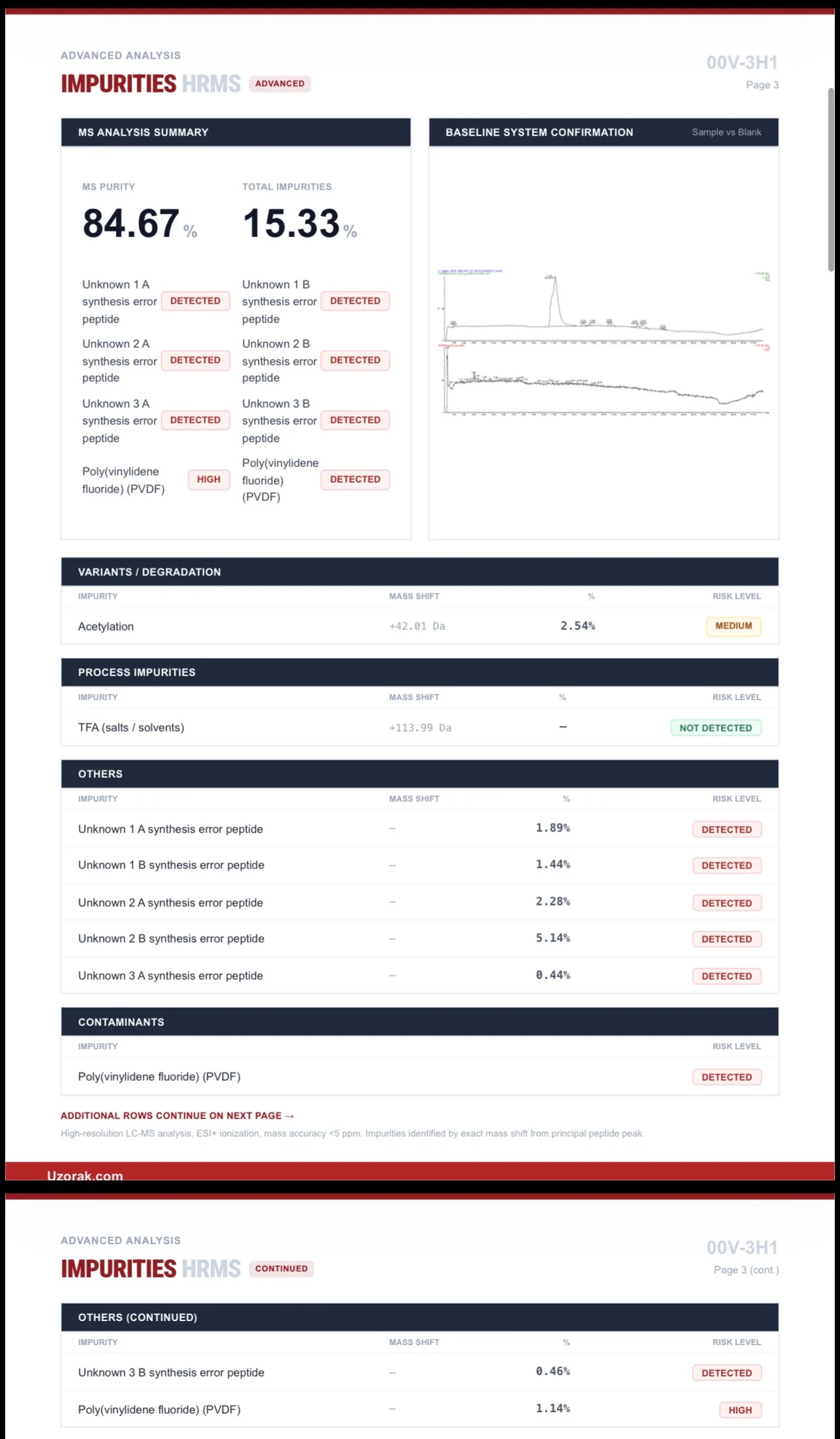
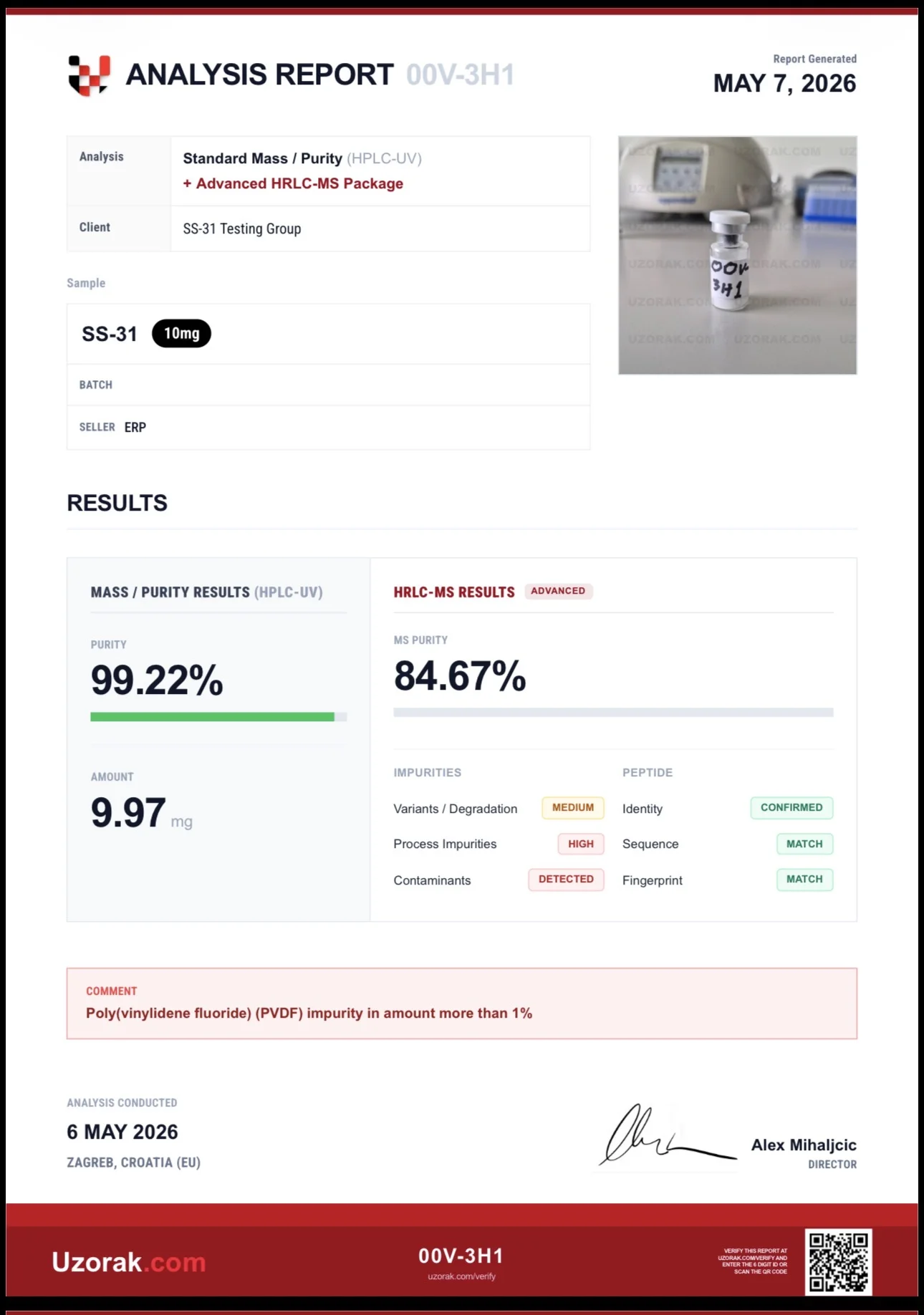
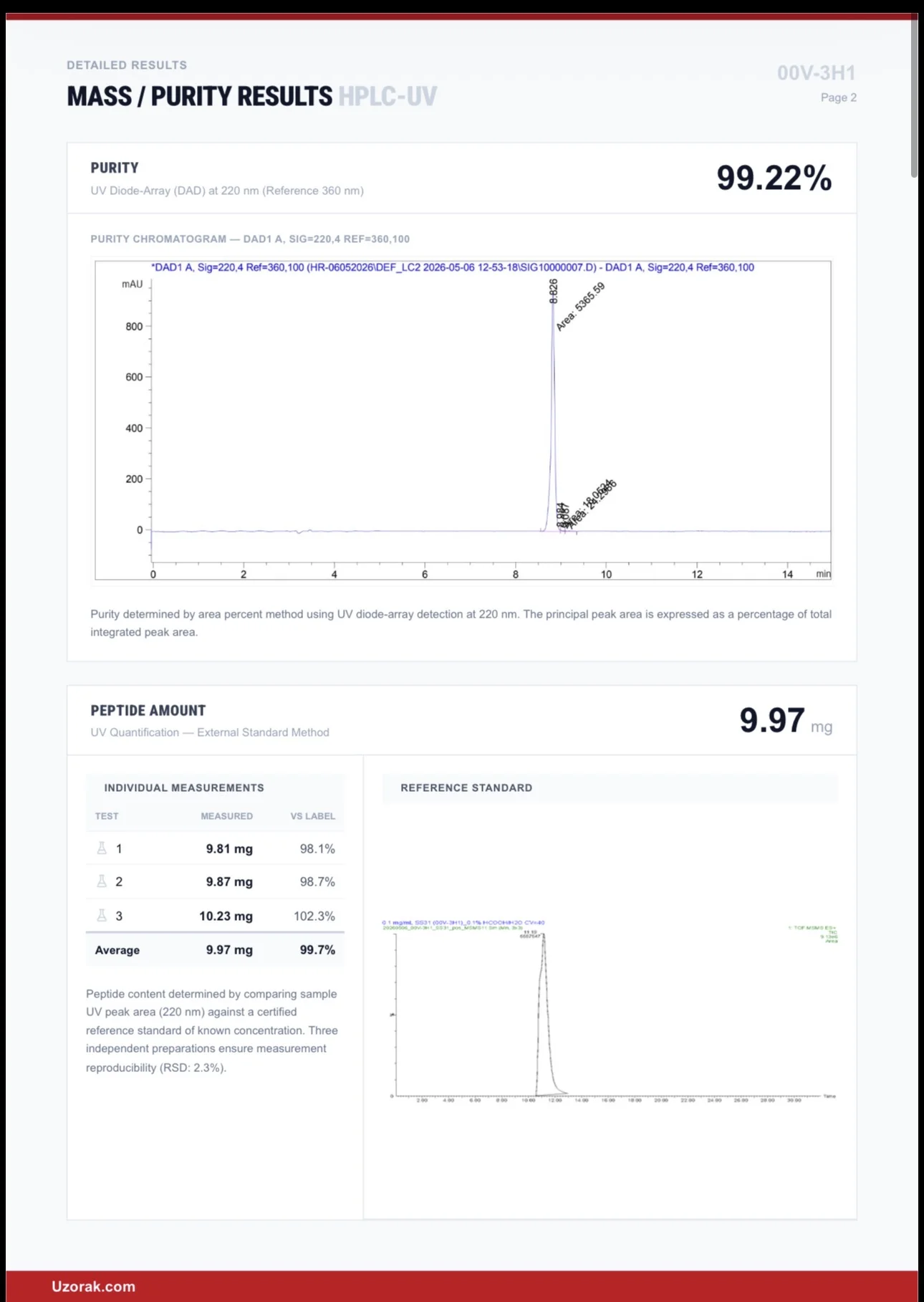
I'm involved with a testing group. The HPLC-UV result should be 99%, but MS, which appears to be more accurate, shows 84.67% purity. MS testing also detected a number of pvdf particulates.

pvdf seems like it could be harmful.

The testing below is for white caps SS-31 10 mg

What does everyone think?


7dcc2dda6b942f0f9d78dd736c542ad7db4faedd97a0c5e99d6589769d3d5f59.webp


de0874697171219ac6218c27825854ce79e2eb56c926bf3b3dd3800163f9a1a4.webp


fef664137a587a3df04e1ba62b2b04a49889fdad47f0e64f987f265276fc327f.webp
 
jjrama said:

Hi All,

I'm involved with a testing group. The HPLC-UV result should be 99%, but MS, which appears to be more accurate, shows 84.67% purity. MS testing also detected a number of pvdf particulates.

pvdf seems like it could be harmful.

The testing below is for white caps SS-31 10 mg

What does everyone think?


View attachment 11670

View attachment 11671

View attachment 11672
Is it not possible to simply remove the pvdf impurities through filtration?
 
Based on what I know — and honestly, that amounts to almost nothing — the answer is no, that isn't possible.
 
I think FSD was the source of this. My advice would be to request your money back.
 
repeated4275 said:

Based on what I know — and honestly, that amounts to almost nothing — the answer is no, that isn't possible.
According to Lou-oogle, particulates can be filtered out - if it were me, I'd throw a .22 micron filter onto that kit, plug and play... then again I reckon I'm already more careful than most, so a bit of risk here and there keeps things interesting.

When people talk about PVDF (polyvinylidene fluoride) impurities in peptides, they usually mean tiny leftover bits or fragments of PVDF membranes (frequently sold under the Durapore name) that flake off into the sample while the peptide is being purified, blotted, or filtered. PVDF gets used a lot because it binds very little protein, but it can still foul delicate work such as mass spectrometry (MS) or cell-based assays. [1, 2, 3, 4, 5]

Is a 0.22 \(\mu \)m filter able to catch PVDF impurities? [1]

Yes, the standard approach for clearing particulate PVDF contamination is a 0.22 \(\mu \)m (0.22 micron) filter. [1]

  • Mechanism: Particles, aggregates, and bacteria are what a 0.22 \(\mu \)m syringe filter is made to trap, while the dissolved peptide passes straight through and solid debris stays behind.
  • Recommended Filter Material: When working with peptides, a 0.22 \(\mu \)m PES (Polyethersulfone) filter is usually the better pick than a PVDF one, since it avoids adding yet more PVDF material.
  • Limitation: Solid particles are removed this way, but soluble chemical contaminants are not. [1, 2, 3, 4, 5]
Key Considerations

  • PES is Often Better: Because they bind little and flow fast, Polyethersulfone (PES) filters are commonly regarded as the "gold standard" for filtering peptides.
  • Avoid Clogging: A heavily contaminated solution can clog the filter, in which case a bigger pore size (e.g., 0.45 \(\mu \)m) may be needed as a pre-filter.
  • What it does NOT do: Endotoxins (pyrogens) and soluble chemical impurities are not removed by a 0.22 \(\mu \)m filter.
  • Alternative Cleanup: Where particulates are dense, spinning the sample at 10,000 RPM for 10 minutes works well as another way to clear out solid particles. [1, 2, 3, 4, 5]
To finish with sterilization or to clear out fine particles, run the solution through a 0.22 \(\mu \)m low-protein binding filter (PES or PVDF, for example) so the peptide solution ends up clean, sterile, and of high quality. [1, 2, 3, 4, 5]
 
E R P, J E E P, and U T H E R are each being looked at closely, and the last 2 have in fact been disqualified from STG because they showed no responsibility and no transparency.

Since a lot of the products we receive from CN do not pass sterility, and more recently endos, I run them through filtration 2 times: the first pass for sterility, and the second (acrodisc) for endos.
 
dancs said:

E R P, J E E P, and U T H E R are each being looked at closely, and the last 2 have in fact been disqualified from STG because they showed no responsibility and no transparency.

Since a lot of the products we receive from CN do not pass sterility, and more recently endos, I run them through filtration 2 times: the first pass for sterility, and the second (acrodisc) for endos.
I looked these auto disc filters up on Google just now, and the prices seem really high. Maybe I'm not finding the right product, though?
 
theflyinggiraffe said:

dancs said:

E R P, J E E P, and U T H E R are each being looked at closely, and the last 2 have in fact been disqualified from STG because they showed no responsibility and no transparency.

Since a lot of the products we receive from CN do not pass sterility, and more recently endos, I run them through filtration 2 times: the first pass for sterility, and the second (acrodisc) for endos.
I looked these auto disc filters up on Google just now, and the prices seem really high. Maybe I'm not finding the right product, though?
The Membrane E Mustang Acrodisk Filters from Cytovia run about $300 for a 10-pack. Other sites sell generic versions; you can get 50 for $250.

That said, don't follow my lead on this one, since I learned these filters are capable of removing endotoxins as well as the compound you actually want. 😔

The standard filters that simply help sterilize the product are still fine to use, but skip the ones I brought up earlier.
 
dancs said:


Membrane E Mustang Acrodisk Filters made by Cytovia; 10 for like $300. You can get generic ones from other sites; 50 pack for $250.

But don't take my advice regarding this because I found out that these filters can take out endotoxins AND the actual compound itself. 😔

You can still get the regular filters that help sterilize the product, but don't get the ones I mentioned before.

Click to expand...
Yeah, I do filter already, but your mention of the Endo ones caught my eye and made me wonder 😂 appreciate it!
 
Isn't it standard for most labs to filter prior to testing? If the filtration eliminated the problematic component, wouldn't that component already be gone?
 
Back
Top