
Reta Triumph 1: New Results

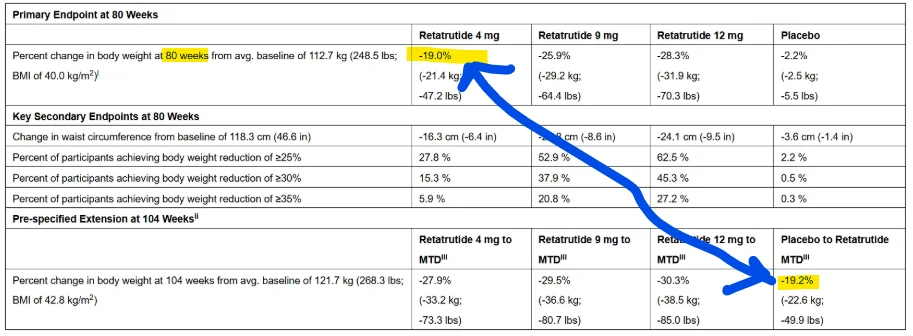
What I was pointing out is that the 4mg arm shed 19% of baseline body weight across 80 weeks, while the placebo arm shed 19.2% across 24 weeks. That's a huge gap in how long people stayed on the drug to end up at roughly the same place. Strip out the 2.2% the placebo arm dropped over the initial 80 weeks and the numbers still land almost identically.


59635fa26a421daa4f77aef6b5841a53bc5b5328630b6a7583698ad6603b3c19.webp


Speaking for myself, given a pick between dropping 50 pounds over 6 months or dropping 50 pounds over 1.5 years, I'd choose the first option, not the second.

Plenty of folks on the forum post asking what to do once they stall or plateau on these meds, and far fewer are asking how to make weight loss go slower.

That said, low and slow clearly does work. Likely a better fit for those who begin treatment in a less diseased state. One of my family members dropped 50lbs on under 2mg of tirzepatide across 9 months. She was never obese her whole life, though, and wouldn't have satisfied the clinical criteria for the meds to begin with.

Given that you've only got 10lbs to lose, none of what I said was aimed at you. Stack TRT, reta, plus a bit of tesa and your abs will appear sooner than you expect.
 
Grogu said:

What I was pointing out is that the 4mg arm shed 19% of baseline body weight across 80 weeks, while the placebo arm shed 19.2% across 24 weeks. That's a huge gap in how long people stayed on the drug to end up at roughly the same place. Strip out the 2.2% the placebo arm dropped over the initial 80 weeks and the numbers still land almost identically.


View attachment 10013

Speaking for myself, given a pick between dropping 50 pounds over 6 months or dropping 50 pounds over 1.5 years, I'd choose the first option, not the second.

Plenty of folks on the forum post asking what to do once they stall or plateau on these meds, and far fewer are asking how to make weight loss go slower.

That said, low and slow clearly does work. Likely a better fit for those who begin treatment in a less diseased state. One of my family members dropped 50lbs on under 2mg of tirzepatide across 9 months. She was never obese her whole life, though, and wouldn't have satisfied the clinical criteria for the meds to begin with.

Given that you've only got 10lbs to lose, none of what I said was aimed at you. Stack TRT, reta, plus a bit of tesa and your abs will appear sooner than you expect.
As far as I know, participants in that arm were escalated until they hit the highest dose they could handle. So the 4mg figure at week 80 doesn't reflect the actual dosing, from what I gather.
 
cujet said:

Grogu said:

What I was pointing out is that the 4mg arm shed 19% of baseline body weight across 80 weeks, while the placebo arm shed 19.2% across 24 weeks. That's a huge gap in how long people stayed on the drug to end up at roughly the same place. Strip out the 2.2% the placebo arm dropped over the initial 80 weeks and the numbers still land almost identically.


View attachment 10013

Speaking for myself, given a pick between dropping 50 pounds over 6 months or dropping 50 pounds over 1.5 years, I'd choose the first option, not the second.

Plenty of folks on the forum post asking what to do once they stall or plateau on these meds, and far fewer are asking how to make weight loss go slower.

That said, low and slow clearly does work. Likely a better fit for those who begin treatment in a less diseased state. One of my family members dropped 50lbs on under 2mg of tirzepatide across 9 months. She was never obese her whole life, though, and wouldn't have satisfied the clinical criteria for the meds to begin with.

Given that you've only got 10lbs to lose, none of what I said was aimed at you. Stack TRT, reta, plus a bit of tesa and your abs will appear sooner than you expect.
As far as I know, participants in that arm were escalated until they hit the highest dose they could handle. So the 4mg figure at week 80 doesn't reflect the actual dosing, from what I gather.

Actually, that's not the case.

ed3d6210862fa2c0f72edc57eae76ffdb3eb34e8392d0291f70206d0d4f16e91.webp
 
lessthanhalf said:

What stands out is that people kept losing weight past the 80-week mark when their dose went up. That tells me the point where weight loss stalls has more to do with how much you're taking than how long you've been on it.

Also, a 25% vomiting rate at 9 or 12mg isn't great.
Lucky I put some reta aside! 20 vials at 60mg are in my stash.
 
Grogu said:

cujet said:

Grogu said:

What I was pointing out is that the 4mg arm shed 19% of baseline body weight across 80 weeks, while the placebo arm shed 19.2% across 24 weeks. That's a huge gap in how long people stayed on the drug to end up at roughly the same place. Strip out the 2.2% the placebo arm dropped over the initial 80 weeks and the numbers still land almost identically.


View attachment 10013

Speaking for myself, given a pick between dropping 50 pounds over 6 months or dropping 50 pounds over 1.5 years, I'd choose the first option, not the second.

Plenty of folks on the forum post asking what to do once they stall or plateau on these meds, and far fewer are asking how to make weight loss go slower.

That said, low and slow clearly does work. Likely a better fit for those who begin treatment in a less diseased state. One of my family members dropped 50lbs on under 2mg of tirzepatide across 9 months. She was never obese her whole life, though, and wouldn't have satisfied the clinical criteria for the meds to begin with.

Given that you've only got 10lbs to lose, none of what I said was aimed at you. Stack TRT, reta, plus a bit of tesa and your abs will appear sooner than you expect.
As far as I know, participants in that arm were escalated until they hit the highest dose they could handle. So the 4mg figure at week 80 doesn't reflect the actual dosing, from what I gather.

Actually, that's not the case.

View attachment 10014
My reading of it is different. A 19% loss was seen in the 4mg group, which doesn't line up with the 28% weight loss at 12mg. On another note, when the 4mg group was titrated up to the maximum tolerated dose, they lost the same 28% as the 12mg group across 104 weeks. The placebo group, titrated up to the maximum tolerated dose, lost 19% of body weight.

Most likely the placebo group had less time on Reta.

Where am I going wrong?

Edited for typo
 
cujet said:


What am I missing?

Click to expand...

At week 80, the 4mg dose arm was still receiving 4mg. Here is what you stated about the 4mg group:

Grogu said:

What I was pointing out is that the 4mg arm shed 19% of baseline body weight across 80 weeks, while the placebo arm shed 19.2% across 24 weeks. That's a huge gap in how long people stayed on the drug to end up at roughly the same place. Strip out the 2.2% the placebo arm dropped over the initial 80 weeks and the numbers still land almost identically.


View attachment 10013

Speaking for myself, given a pick between dropping 50 pounds over 6 months or dropping 50 pounds over 1.5 years, I'd choose the first option, not the second.

Plenty of folks on the forum post asking what to do once they stall or plateau on these meds, and far fewer are asking how to make weight loss go slower.

That said, low and slow clearly does work. Likely a better fit for those who begin treatment in a less diseased state. One of my family members dropped 50lbs on under 2mg of tirzepatide across 9 months. She was never obese her whole life, though, and wouldn't have satisfied the clinical criteria for the meds to begin with.

Given that you've only got 10lbs to lose, none of what I said was aimed at you. Stack TRT, reta, plus a bit of tesa and your abs will appear sooner than you expect.
As far as I know, participants in that arm were escalated until they hit the highest dose they could handle. So the 4mg figure at week 80 doesn't reflect the actual dosing, from what I gather.

However, at week 80 the 4mg group remained on 4mg. The increase happened afterward.
 
Grogu said:


…And it's not the same 28%. The 12mg group lost 30.3% and the 4mg group lost 27.9% at 104 weeks. That's a difference of 2.4% or about 12 pounds difference in loss. That's not the same.

Click to expand...

The 4mg and 12mg groups show very different exposure-over-time curves. Comparing their probable maximum loss at 12mg directly is not fair: 24 weeks vs 104 weeks.
 
woundcarping said:

Grogu said:


…And it's not the same 28%. The 12mg group lost 30.3% and the 4mg group lost 27.9% at 104 weeks. That's a difference of 2.4% or about 12 pounds difference in loss. That's not the same.

Click to expand...

The 4mg and 12mg groups show very different exposure-over-time curves. Comparing their probable maximum loss at 12mg directly is not fair: 24 weeks vs 104 weeks.

Yet it mirrors how people really act. A person comes across social media claims that smaller doses work best, so they choose to remain at a low dose. Once 80 weeks pass, they notice their progress is not what it ought to be and begin moving up to larger doses. By then it is too late.... 27.9% does not equal 30.3%. Both at 104 weeks.
 
Grogu said:

woundcarping said:

Grogu said:


…And it's not the same 28%. The 12mg group lost 30.3% and the 4mg group lost 27.9% at 104 weeks. That's a difference of 2.4% or about 12 pounds difference in loss. That's not the same.

Click to expand...

The 4mg and 12mg groups show very different exposure-over-time curves. Comparing their probable maximum loss at 12mg directly is not fair: 24 weeks vs 104 weeks.

Yet it mirrors how people really act. A person comes across social media claims that smaller doses work best, so they choose to remain at a low dose. Once 80 weeks pass, they notice their progress is not what it ought to be and begin moving up to larger doses. By then it is too late.... 27.9% does not equal 30.3%. Both at 104 weeks.

No way are those the same weeks on an identical curve.

One arm took 24 weeks to go from 4mg up to 12mg, whereas the other arm stayed at 12mg for 104 weeks.

In my opinion, to get a fair endpoint comparison you'd need to look at the titrating group's results at 184 weeks.
 
woundcarping said:

Grogu said:

woundcarping said:

Grogu said:


…And it's not the same 28%. The 12mg group lost 30.3% and the 4mg group lost 27.9% at 104 weeks. That's a difference of 2.4% or about 12 pounds difference in loss. That's not the same.

Click to expand...

The 4mg and 12mg groups show very different exposure-over-time curves. Comparing their probable maximum loss at 12mg directly is not fair: 24 weeks vs 104 weeks.

Yet it mirrors how people really act. A person comes across social media claims that smaller doses work best, so they choose to remain at a low dose. Once 80 weeks pass, they notice their progress is not what it ought to be and begin moving up to larger doses. By then it is too late.... 27.9% does not equal 30.3%. Both at 104 weeks.

No way are those the same weeks on an identical curve.

One arm took 24 weeks to go from 4mg up to 12mg, whereas the other arm stayed at 12mg for 104 weeks.

In my opinion, to get a fair endpoint comparison you'd need to look at the titrating group's results at 184 weeks.

In my opinion, 104 weeks equals 104 weeks. Same comparison. One set of rats stayed low and slow across 80 weeks, while the other rats moved up quickly, yet both sets were under medication for an identical total duration. The 4mg set wasn't given placebo, after all.

Should someone claim the 12mg set remained at that dose longer (assuming that's the curve under discussion), then precisely... that explains the greater weight loss in those rats. 🤣
 
Grogu said:


The 4mg dose arm of the study was on 4mg at week 80. What you said in regards to the 4mg group was:

But the 4mg group was on 4mg at week 80. It went up after that.

Click to expand...
Appreciate it—I saw that, but my wording was off. Fixed now.
 
cujet said:


Thanks, I read that but wrote the wrong thing. Corrected.

Click to expand...

No worries at all. We didn't have the full study in front of us—only what the press release shared. Plus, when it comes to titration, this trial differs from many other glp-1 clinical studies. The research design was quite interesting.

Also—I'm in PB County as well, just further south.
 
Back
Top