NYT Magazine on the Male Testosterone Boom

A Reddit thread about chasing real results instead of a number on a blood test - sometimes that happens at a lower dose than you’d expect:


https://www.reddit.com/r/Testosterone/s/UfMJy0IlW2


a194b3b24f146d5be63317f2150472e8421b12f68d8724dd79bcd7171888ed80.webp


View: https://m.youtube.com/watch?v=mwgJVimtq-g
 
Calm Logic said:

A Reddit thread about chasing real results instead of a number on a blood test - sometimes that happens at a lower dose than you’d expect:


https://www.reddit.com/r/Testosterone/s/UfMJy0IlW2


View attachment 252

View: https://m.youtube.com/watch?v=mwgJVimtq-g
Interesting - there are viewpoints pulling against your posts, just as there are across this whole topic.

Calm Logic said:

Why So Many Guys Are Obsessed With Testosterone​#-why-so-many-guys-are-obsessed-with-testosteroneMarch/May 2026

...One more thing that muddies the picture: everyday problems such as obesity, stress, poor sleep and diabetes can drag testosterone down all by themselves, which turns the whole thing into a loop that feeds itself. Plenty of physicians push men to fix diet and training first and see whether T climbs back naturally, before anyone commits to T.R.T. Dr. Mohit Khera, a urologist at Baylor College of Medicine, argues that age on its own barely shifts T at all, and lays part of the blame on the fact that, as a population, we simply keep getting sicker.

...Because online clinics hand testosterone out so indiscriminately, the one thing most of those men will actually get is extra muscle. For plenty of them that is more than enough. The sales pitch, though, usually promises far more, insisting testosterone could repair both mind and body. “Online, everyone is saying testosterone is the solution to all of your problems,” Dubin says, then adds the plain caveat that it very clearly is not.

Without paywall: http://archive.today/2026.05.30-100...azine/testosterone-masculinity-trump-rfk.html

Further reading:


Muscle Dysmorphia, Obsessive–Compulsive Traits, and Anabolic Steroid Use: A Systematic Review and Meta-Analysis - PMC


Muscle dysmorphia (MD) describes a body image disorder built on obsessive preoccupation with muscularity, together with compulsive habits such as over-exercising, rigid dieting and constantly inspecting the body. Researchers have tied MD to obsessive–compulsive ...

View attachment 249


pmc.ncbi.nlm.nih.gov

"Muscle dysmorphia...exists at the intersection of obsessive–compulsive psychopathology and substance-related behavior"


https://gertitashkomd.com/high-dose-trt-and-tendon-ruptures-whats-the-risk/


View attachment 250

And then you put up this image showing the decline with age.

32b27275d10cb65badebded8f5863dadd066cf7ad699c27cf4284fcf8d100cfc.webp


I watched the whole video, start to finish, and the doctor was only citing labs alongside symptoms as a possible reason to think about treatment.

He also drew a clear line between what “replacement” requires and what someone simply wants.

On the whole he came across as supportive where support was warranted.

I do think the want-over-need crowd has no business bringing sand to the beach!

He also covered how differently people respond, and how that shifts the total dose.

Taken together, the 2 posts strike me as contradictory, and so is the entire argument.

Great Data, as always, and your Dr. had plenty worth listening to.
 
On the age versus effort question, here are some AI projections for testosterone:

Gemini said:


AgePopulation Median (General)Optimized Median (Active/Resistance Training)20~625~650 – 75030~525~575 – 65040~475~525 – 60050~425~500 – 57560~375~450 – 55070~325~400 – 50080~275~350 – 450

Click to expand...
Beyond lifting weights, those naturally optimized figures also build in things such as lower body fat:

Gemini said:


FactorOptimized StateBody FatGenerally 10% – 15% (for men)Sleep7–9 hours of high-efficiency sleepInflammationLow (low CRP/ESR markers)NutrientsSufficient Zinc, Magnesium, Vit D, and healthy fatsStressManaged (low chronic cortisol exposure)

Click to expand...
 
Calm Logic said:

On the age versus effort question, here are some AI projections for testosterone:

Gemini said:


AgePopulation Median (General)Optimized Median (Active/Resistance Training)20~625~650 – 75030~525~575 – 65040~475~525 – 60050~425~500 – 57560~375~450 – 55070~325~400 – 50080~275~350 – 450

Click to expand...
Beyond lifting weights, those naturally optimized figures also build in things such as lower body fat:

Gemini said:


FactorOptimized StateBody FatGenerally 10% – 15% (for men)Sleep7–9 hours of high-efficiency sleepInflammationLow (low CRP/ESR markers)NutrientsSufficient Zinc, Magnesium, Vit D, and healthy fatsStressManaged (low chronic cortisol exposure)

Click to expand...
That graphic you shared on natural Test boosters was genuinely useful - I was telling a friend to try a few of them before reaching for the needle, and I could recall Boron and Ashwagandha but not the rest.

BMI matters here in a lot of ways, not just for the natural drop but for possible estradiol problems too.

There is a huge amount to weigh up, and after 1 year of TRT I’m still finding new ones.

I’m glad it can be talked about openly, even if only up to a point. Plenty of people would reach for this as a quick fix for lost muscle, but the subject runs far deeper than that.
 
Skidude said:

Calm Logic said:

Why So Many Guys Are Obsessed With Testosterone​#-why-so-many-guys-are-obsessed-with-testosteroneMarch/May 2026

...One more thing that muddies the picture: everyday problems such as obesity, stress, poor sleep and diabetes can drag testosterone down all by themselves, which turns the whole thing into a loop that feeds itself. Plenty of physicians push men to fix diet and training first and see whether T climbs back naturally, before anyone commits to T.R.T. Dr. Mohit Khera, a urologist at Baylor College of Medicine, argues that age on its own barely shifts T at all, and lays part of the blame on the fact that, as a population, we simply keep getting sicker.

...Because online clinics hand testosterone out so indiscriminately, the one thing most of those men will actually get is extra muscle. For plenty of them that is more than enough. The sales pitch, though, usually promises far more, insisting testosterone could repair both mind and body. “Online, everyone is saying testosterone is the solution to all of your problems,” Dubin says, then adds the plain caveat that it very clearly is not.

Without paywall: http://archive.today/2026.05.30-100...azine/testosterone-masculinity-trump-rfk.html

Further reading:


Muscle Dysmorphia, Obsessive–Compulsive Traits, and Anabolic Steroid Use: A Systematic Review and Meta-Analysis - PMC


Muscle dysmorphia (MD) describes a body image disorder built on obsessive preoccupation with muscularity, together with compulsive habits such as over-exercising, rigid dieting and constantly inspecting the body. Researchers have tied MD to obsessive–compulsive ...

View attachment 249


pmc.ncbi.nlm.nih.gov

"Muscle dysmorphia...exists at the intersection of obsessive–compulsive psychopathology and substance-related behavior"


https://gertitashkomd.com/high-dose-trt-and-tendon-ruptures-whats-the-risk/


View attachment 250
Genuinely appreciate the feedback, and I respect the “harm reduction” aim.

The wording a lot of these studies use, plus the assumption that TRT exists only for cosmetic or vanity reasons, looks like an overstated conclusion to me.

I am talking about TRT only here. I have not gone anywhere near supraphysiological dosing.

I would agree that many of us, myself included, are after every benefit going - which takes in wanting to look better as much as feel better.

I also think it’s a slippery slope, the same as most of the peps and compounds we buy with no grasp of the full physiological picture. That area is unquestionably more dangerous and can leave lasting damage.

That said, I agree with a few of the points I’m about to paste in: people differ, high doses are hard to work out when labs show no big reaction, and there is plenty on offer besides muscle.

What do you make of this:

A dose of 150 mg per week is not considered a high dose when that is what your body needs to sit in a normal, healthy physiological range. [1, 2]

Whatever you were reading was probably leaning on older clinical guidance or strict academic protocols, which tend to treat 100 mg per week as the ceiling for replacement. Modern TRT clinics and their specialists accept that real-world biology is all over the place. [1, 4]

Why 150 mg Counts as Standard, Not “High”

  • Individual Metabolism: No two men clear exogenous hormones at the same speed. A 100 mg dose could leave one man sitting at a healthy 700 ng/dL while another stays subtherapeutic at 350 ng/dL. [1, 2]
  • The Role of SHBG: SHBG (Sex Hormone-Binding Globulin) soaks up testosterone like a sponge. When a man’s SHBG runs high he will usually need more per week (often 150 mg to 200 mg) simply to release enough active testosterone into his tissues. [1, 2, 4]
  • Clinic vs. Academic Disconnect: Older academic literature tends to aim at the smallest dose that clears the basic clinical symptoms. Specialized modern clinics instead tune levels up into the upper-normal physiological range (typically 700 to 1,000 ng/dL), where patients describe the strongest symptom relief. [1, 2, 4]

What the TRT range actually looks like

Injectable testosterone (cypionate or enanthate) is broadly split by medical consensus into these bands: 2, 3, 4, 5]

  • Low/Conservative Dose (75–100 mg/week): Best suited to men who respond strongly, who run low SHBG, or who are older.
  • Moderate/Common Dose (100–150 mg/week): The usual “sweet spot” for most men on TRT.
  • Higher Therapeutic Dose (150–200 mg/week): Often needed by bigger men, fast metabolizers, or anyone with high SHBG.
  • Abnormal / Performance Doses (200 mg+ / week): Seldom needed for genuine medical replacement; go into this territory and the odds of side effects climb, such as thick blood (high hematocrit) or elevated estrogen. [1, 2, 3]
In the end, the figure in the syringe counts for far less than what the blood work shows. If 150 mg lands your trough levels (the low point just before the next injection) inside a standard, healthy male range, then it is legally, medically and biologically a replacement dose—not a “high” or performance-enhancing dose.

Per my doc, once the red cells run too high, go give blood. That struck me as fairly generic advice. She had no issue at all with my Reta Test stack.
 
deleted.user.27 said:

Skidude said:

Calm Logic said:

Why So Many Guys Are Obsessed With Testosterone​#-why-so-many-guys-are-obsessed-with-testosteroneMarch/May 2026

...One more thing that muddies the picture: everyday problems such as obesity, stress, poor sleep and diabetes can drag testosterone down all by themselves, which turns the whole thing into a loop that feeds itself. Plenty of physicians push men to fix diet and training first and see whether T climbs back naturally, before anyone commits to T.R.T. Dr. Mohit Khera, a urologist at Baylor College of Medicine, argues that age on its own barely shifts T at all, and lays part of the blame on the fact that, as a population, we simply keep getting sicker.

...Because online clinics hand testosterone out so indiscriminately, the one thing most of those men will actually get is extra muscle. For plenty of them that is more than enough. The sales pitch, though, usually promises far more, insisting testosterone could repair both mind and body. “Online, everyone is saying testosterone is the solution to all of your problems,” Dubin says, then adds the plain caveat that it very clearly is not.

Without paywall: http://archive.today/2026.05.30-100...azine/testosterone-masculinity-trump-rfk.html

Further reading:


Muscle Dysmorphia, Obsessive–Compulsive Traits, and Anabolic Steroid Use: A Systematic Review and Meta-Analysis - PMC


Muscle dysmorphia (MD) describes a body image disorder built on obsessive preoccupation with muscularity, together with compulsive habits such as over-exercising, rigid dieting and constantly inspecting the body. Researchers have tied MD to obsessive–compulsive ...

View attachment 249


pmc.ncbi.nlm.nih.gov

"Muscle dysmorphia...exists at the intersection of obsessive–compulsive psychopathology and substance-related behavior"


https://gertitashkomd.com/high-dose-trt-and-tendon-ruptures-whats-the-risk/


View attachment 250
Genuinely appreciate the feedback, and I respect the “harm reduction” aim.

The wording a lot of these studies use, plus the assumption that TRT exists only for cosmetic or vanity reasons, looks like an overstated conclusion to me.

I am talking about TRT only here. I have not gone anywhere near supraphysiological dosing.

I would agree that many of us, myself included, are after every benefit going - which takes in wanting to look better as much as feel better.

I also think it’s a slippery slope, the same as most of the peps and compounds we buy with no grasp of the full physiological picture. That area is unquestionably more dangerous and can leave lasting damage.

That said, I agree with a few of the points I’m about to paste in: people differ, high doses are hard to work out when labs show no big reaction, and there is plenty on offer besides muscle.

What do you make of this:

A dose of 150 mg per week is not considered a high dose when that is what your body needs to sit in a normal, healthy physiological range. [1, 2]

Whatever you were reading was probably leaning on older clinical guidance or strict academic protocols, which tend to treat 100 mg per week as the ceiling for replacement. Modern TRT clinics and their specialists accept that real-world biology is all over the place. [1, 4]

Why 150 mg Counts as Standard, Not “High”

  • Individual Metabolism: No two men clear exogenous hormones at the same speed. A 100 mg dose could leave one man sitting at a healthy 700 ng/dL while another stays subtherapeutic at 350 ng/dL. [1, 2]
  • The Role of SHBG: SHBG (Sex Hormone-Binding Globulin) soaks up testosterone like a sponge. When a man’s SHBG runs high he will usually need more per week (often 150 mg to 200 mg) simply to release enough active testosterone into his tissues. [1, 2, 4]
  • Clinic vs. Academic Disconnect: Older academic literature tends to aim at the smallest dose that clears the basic clinical symptoms. Specialized modern clinics instead tune levels up into the upper-normal physiological range (typically 700 to 1,000 ng/dL), where patients describe the strongest symptom relief. [1, 2, 4]

What the TRT range actually looks like

Injectable testosterone (cypionate or enanthate) is broadly split by medical consensus into these bands: 2, 3, 4, 5]

  • Low/Conservative Dose (75–100 mg/week): Best suited to men who respond strongly, who run low SHBG, or who are older.
  • Moderate/Common Dose (100–150 mg/week): The usual “sweet spot” for most men on TRT.
  • Higher Therapeutic Dose (150–200 mg/week): Often needed by bigger men, fast metabolizers, or anyone with high SHBG.
  • Abnormal / Performance Doses (200 mg+ / week): Seldom needed for genuine medical replacement; go into this territory and the odds of side effects climb, such as thick blood (high hematocrit) or elevated estrogen. [1, 2, 3]
In the end, the figure in the syringe counts for far less than what the blood work shows. If 150 mg lands your trough levels (the low point just before the next injection) inside a standard, healthy male range, then it is legally, medically and biologically a replacement dose—not a “high” or performance-enhancing dose.
Per my doc, once the red cells run too high, go give blood. That struck me as fairly generic advice. She had no issue at all with my Reta Test stack.
Reta and the other GLP1s can leave you dehydrated as well

The blood bank could technically object to Reta specifically, since they screen for research chemicals (no idea about PA)

At worst, a Doc can order a therapeutic (prescribed) phlebotomy.
 
Skidude said:

deleted.user.27 said:

Skidude said:

Calm Logic said:

Why So Many Guys Are Obsessed With Testosterone​#-why-so-many-guys-are-obsessed-with-testosteroneMarch/May 2026

...One more thing that muddies the picture: everyday problems such as obesity, stress, poor sleep and diabetes can drag testosterone down all by themselves, which turns the whole thing into a loop that feeds itself. Plenty of physicians push men to fix diet and training first and see whether T climbs back naturally, before anyone commits to T.R.T. Dr. Mohit Khera, a urologist at Baylor College of Medicine, argues that age on its own barely shifts T at all, and lays part of the blame on the fact that, as a population, we simply keep getting sicker.

...Because online clinics hand testosterone out so indiscriminately, the one thing most of those men will actually get is extra muscle. For plenty of them that is more than enough. The sales pitch, though, usually promises far more, insisting testosterone could repair both mind and body. “Online, everyone is saying testosterone is the solution to all of your problems,” Dubin says, then adds the plain caveat that it very clearly is not.

Without paywall: http://archive.today/2026.05.30-100...azine/testosterone-masculinity-trump-rfk.html

Further reading:


Muscle Dysmorphia, Obsessive–Compulsive Traits, and Anabolic Steroid Use: A Systematic Review and Meta-Analysis - PMC


Muscle dysmorphia (MD) describes a body image disorder built on obsessive preoccupation with muscularity, together with compulsive habits such as over-exercising, rigid dieting and constantly inspecting the body. Researchers have tied MD to obsessive–compulsive ...

View attachment 249


pmc.ncbi.nlm.nih.gov

"Muscle dysmorphia...exists at the intersection of obsessive–compulsive psychopathology and substance-related behavior"


https://gertitashkomd.com/high-dose-trt-and-tendon-ruptures-whats-the-risk/


View attachment 250
Genuinely appreciate the feedback, and I respect the “harm reduction” aim.

The wording a lot of these studies use, plus the assumption that TRT exists only for cosmetic or vanity reasons, looks like an overstated conclusion to me.

I am talking about TRT only here. I have not gone anywhere near supraphysiological dosing.

I would agree that many of us, myself included, are after every benefit going - which takes in wanting to look better as much as feel better.

I also think it’s a slippery slope, the same as most of the peps and compounds we buy with no grasp of the full physiological picture. That area is unquestionably more dangerous and can leave lasting damage.

That said, I agree with a few of the points I’m about to paste in: people differ, high doses are hard to work out when labs show no big reaction, and there is plenty on offer besides muscle.

What do you make of this:

A dose of 150 mg per week is not considered a high dose when that is what your body needs to sit in a normal, healthy physiological range. [1, 2]

Whatever you were reading was probably leaning on older clinical guidance or strict academic protocols, which tend to treat 100 mg per week as the ceiling for replacement. Modern TRT clinics and their specialists accept that real-world biology is all over the place. [1, 4]

Why 150 mg Counts as Standard, Not “High”

  • Individual Metabolism: No two men clear exogenous hormones at the same speed. A 100 mg dose could leave one man sitting at a healthy 700 ng/dL while another stays subtherapeutic at 350 ng/dL. [1, 2]
  • The Role of SHBG: SHBG (Sex Hormone-Binding Globulin) soaks up testosterone like a sponge. When a man’s SHBG runs high he will usually need more per week (often 150 mg to 200 mg) simply to release enough active testosterone into his tissues. [1, 2, 4]
  • Clinic vs. Academic Disconnect: Older academic literature tends to aim at the smallest dose that clears the basic clinical symptoms. Specialized modern clinics instead tune levels up into the upper-normal physiological range (typically 700 to 1,000 ng/dL), where patients describe the strongest symptom relief. [1, 2, 4]

What the TRT range actually looks like

Injectable testosterone (cypionate or enanthate) is broadly split by medical consensus into these bands: 2, 3, 4, 5]

  • Low/Conservative Dose (75–100 mg/week): Best suited to men who respond strongly, who run low SHBG, or who are older.
  • Moderate/Common Dose (100–150 mg/week): The usual “sweet spot” for most men on TRT.
  • Higher Therapeutic Dose (150–200 mg/week): Often needed by bigger men, fast metabolizers, or anyone with high SHBG.
  • Abnormal / Performance Doses (200 mg+ / week): Seldom needed for genuine medical replacement; go into this territory and the odds of side effects climb, such as thick blood (high hematocrit) or elevated estrogen. [1, 2, 3]
In the end, the figure in the syringe counts for far less than what the blood work shows. If 150 mg lands your trough levels (the low point just before the next injection) inside a standard, healthy male range, then it is legally, medically and biologically a replacement dose—not a “high” or performance-enhancing dose.
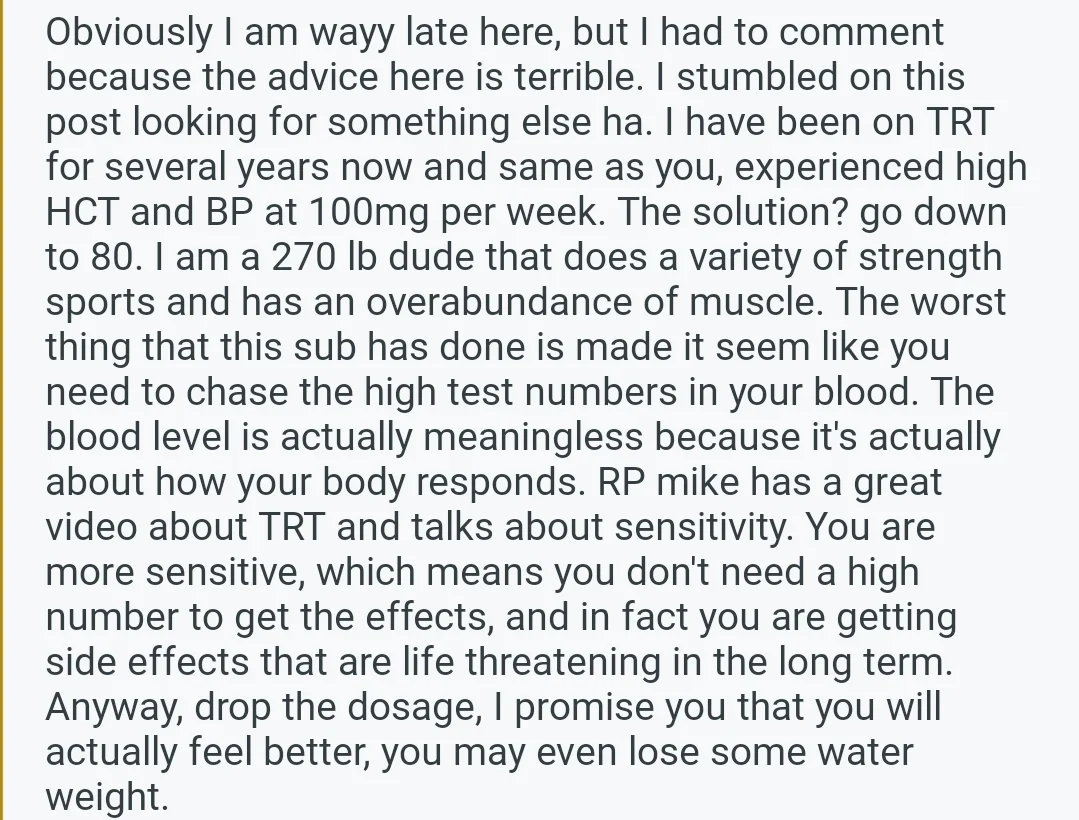
Per my doc, once the red cells run too high, go give blood. That struck me as fairly generic advice. She had no issue at all with my Reta Test stack.
Reta and the other GLP1s can leave you dehydrated as well

The blood bank could technically object to Reta specifically, since they screen for research chemicals (no idea about PA)

At worst, a Doc can order a therapeutic (prescribed) phlebotomy.
They certainly do. Anything you’ve been drinking or taking that ends up in your blood means it can’t be used WHOLE. The plasma they still take. I’m O Positive, so to them I’m fresh blood and they can’t get enough, hounding me with phone calls.
 
Likely because generational low test levels are a huge problem. And it is not getting better. It is getting WORSE. Which is what sends guys down the rabbit hole.

if blokes back in the 1940s were walking around with twice the numbers we manage at half the age. That is a red alarm.

Jack llane could still knock out one thumb pushups in his 90s, and was fitter than 99 percent of guys in their prime today. Sure, he was blasting for decades. Might be connected.

I think there is a straight domino line from the male obesity epidemic to early test levels. Then you look at trt before and afters. I think modern medicine and society want a domesticated male class — fat, docile, weak, bitchy, subservient. Which also shows up in the historic low numbers of military aged men fit for service.

If you are too busy sitting through the office and sobbing because a 50 dollar door dash soy latte turned up cold. How are you supposed to look up and notice what is really happening? How are you supposed to get angry, to want change, when you are comfortably numb? How are you supposed to change anything or lead a family when you have the energy and strength of an anemic Victorian child? The meek will inherit the earth. Because every strong man died and left no children.
 
Back
Top