
"Ferritin came back at 20.3 ng/mL — under the optimal range, so iron stores are low. Even with hemoglobin in the normal range, low ferritin may bring on tiredness, cut into exercise capacity, and get in the way of losing weight and building muscle. With your goals plus TRT/peptide use in the picture, it may be worth tweaking iron intake (heme sources in the diet or a supplement) and retesting ferritin a few months into treatment."

Install the app
How to install the app on iOS
Follow along with the video below to see how to install our site as a web app on your home screen.
- 1. Open your browser's Share menu.
- 2. Choose Add to Home Screen.
- 3. Confirm Add to install glp1chat.
Note: This feature may not be available in some browsers.
You are using an out of date browser. It may not display this or other websites correctly.
You should upgrade or use an alternative browser.
You should upgrade or use an alternative browser.
Low ferritin: what worked for you?
- Thread starter jason370
- Start date

5byfive
Explorer
I just had labs drawn and ran into the same issue, despite my iron being within range. A colonoscopy followed, and it turned up multiple polyps, which seems to be the likely explanation. I don't know your age, but this may be worth considering. I'm going to repeat the bloodwork in roughly a month, though I expect my ferritin will have returned to normal by then.


What number were you actually at? My PA is a total doofus running my medical care, and my ferritin came back at 12.1 last time (iron was 17.9). I sometimes think about what I could do if my body had the right amount of iron. My PA won't do anything except keep ordering tests, and everyone's just waiting on menopause to sort my shit out.dogmom said:
Every couple of years or so, I end up needing iron infusions. Back in January, my ferritin was significantly lower than that. I just went through a round of injections not long ago.
As for the OP, every day I use OTC supplements: 27mg of ferrous gluconate plus Thorne "Advanced Iron Complex" 36mg Ferrous Bisglycinate Chelate, and I also try to regularly eat high iron foods such as oysters/shellfish.
Mine came in at 4cldfront said:
What number were you actually at? My PA is a total doofus running my medical care, and my ferritin came back at 12.1 last time (iron was 17.9). I sometimes think about what I could do if my body had the right amount of iron. My PA won't do anything except keep ordering tests, and everyone's just waiting on menopause to sort my shit out.dogmom said:
Every couple of years or so, I end up needing iron infusions. Back in January, my ferritin was significantly lower than that. I just went through a round of injections not long ago.
As for the OP, every day I use OTC supplements: 27mg of ferrous gluconate plus Thorne "Advanced Iron Complex" 36mg Ferrous Bisglycinate Chelate, and I also try to regularly eat high iron foods such as oysters/shellfish.

FlowerFairy
Explorer
My treatment has involved iron supplementation. Three times per week I take polysaccharide iron alongside vitamin C. On a few occasions, iron infusions have also been necessary.jason370 said:
"Ferritin came back at 20.3 ng/mL — under the optimal range, so iron stores are low. Even with hemoglobin in the normal range, low ferritin may bring on tiredness, cut into exercise capacity, and get in the way of losing weight and building muscle. With your goals plus TRT/peptide use in the picture, it may be worth tweaking iron intake (heme sources in the diet or a supplement) and retesting ferritin a few months into treatment."
According to my hematologist, insufficient stomach acid to absorb ferrous sulfate is common among certain groups, particularly people who have undergone WLS and older adults. He also told me that absorption is actually better when the dose is taken every other day rather than daily. That insight came about because my second round of infusions happened while I was on a daily dose without vitamin C, which left me asking how I could still be so anemic despite taking iron every day.
FlowerFairy
Explorer
cldfront said:
What number were you actually at? My PA is a total doofus running my medical care, and my ferritin came back at 12.1 last time (iron was 17.9). I sometimes think about what I could do if my body had the right amount of iron. My PA won't do anything except keep ordering tests, and everyone's just waiting on menopause to sort my shit out.dogmom said:
Every couple of years or so, I end up needing iron infusions. Back in January, my ferritin was significantly lower than that. I just went through a round of injections not long ago.
As for the OP, every day I use OTC supplements: 27mg of ferrous gluconate plus Thorne "Advanced Iron Complex" 36mg Ferrous Bisglycinate Chelate, and I also try to regularly eat high iron foods such as oysters/shellfish.
Try switching to polysaccharide iron. It gets taken up by the body more effectively, and if ferrous sulfate hasn't helped you at all, that means it isn't being absorbed. I spent years anemic while on FeSO4 too. According to my hematologist, taking it was basically the same as swallowing gravel.
funlog
Explorer
Once I quit trt, my levels returned to normal within a few months.

desinr-gal
Explorer
Being mostly vegan means low iron stores come up for me again and again.
Throughout the day I work in foods that carry iron, and the first one is my coffee. Into a frothed latte go unsweetened cocoa powder and blackstrap molasses, since both deliver a lot of iron. Cinnamon and nutmeg go in as well, which bring the sugar down and make it taste better.
That accounts for 20% daily value.
After that comes a smoothie: protein powder, additional cocoa and molasses, plus creatine, collagen, amino acids and similar items, along with Kale and 1 cup of blueberries for vit C, which doubles how much of the iron the body can use. Whenever you eat or drink iron foods, pair them with citrus.
A cast iron pan helps a great deal, though in hawaii it is a hassle because it rusts so fast.
An iron fish is another option: place it in a pot of water so iron leaches into the water, add a squeeze of lemon once more, then pour it into your water bottle.
Lentils bring both iron and protein, so working them into meals is useful too, particularly when they are cooked alongside spinach and lemon.
Since I began these habits, my iron has stayed normal for years.
Throughout the day I work in foods that carry iron, and the first one is my coffee. Into a frothed latte go unsweetened cocoa powder and blackstrap molasses, since both deliver a lot of iron. Cinnamon and nutmeg go in as well, which bring the sugar down and make it taste better.
That accounts for 20% daily value.
After that comes a smoothie: protein powder, additional cocoa and molasses, plus creatine, collagen, amino acids and similar items, along with Kale and 1 cup of blueberries for vit C, which doubles how much of the iron the body can use. Whenever you eat or drink iron foods, pair them with citrus.
A cast iron pan helps a great deal, though in hawaii it is a hassle because it rusts so fast.
An iron fish is another option: place it in a pot of water so iron leaches into the water, add a squeeze of lemon once more, then pour it into your water bottle.
Lentils bring both iron and protein, so working them into meals is useful too, particularly when they are cooked alongside spinach and lemon.
Since I began these habits, my iron has stayed normal for years.
To stop rust, just put a thin layer of oil on the cast iron pan. If you place it in the oven with that oil on it, the oil will set and form a shield — you’ll need to repeat this every so often.desinr-gal said:
Being mostly vegan means low iron stores come up for me again and again.
Throughout the day I work in foods that carry iron, and the first one is my coffee. Into a frothed latte go unsweetened cocoa powder and blackstrap molasses, since both deliver a lot of iron. Cinnamon and nutmeg go in as well, which bring the sugar down and make it taste better.
That accounts for 20% daily value.
After that comes a smoothie: protein powder, additional cocoa and molasses, plus creatine, collagen, amino acids and similar items, along with Kale and 1 cup of blueberries for vit C, which doubles how much of the iron the body can use. Whenever you eat or drink iron foods, pair them with citrus.
A cast iron pan helps a great deal, though in hawaii it is a hassle because it rusts so fast.
An iron fish is another option: place it in a pot of water so iron leaches into the water, add a squeeze of lemon once more, then pour it into your water bottle.
Lentils bring both iron and protein, so working them into meals is useful too, particularly when they are cooked alongside spinach and lemon.
Since I began these habits, my iron has stayed normal for years.

lessthanhalf
Explorer
A low ferritin result isn't a diagnosis on its own — it's a finding that calls for an explanation. For a pre-menopausal woman, it frequently doesn't warrant a workup, but at age 60 it definitely does, and the same is usually true for men.jason370 said:
"Ferritin came back at 20.3 ng/mL — under the optimal range, so iron stores are low. Even with hemoglobin in the normal range, low ferritin may bring on tiredness, cut into exercise capacity, and get in the way of losing weight and building muscle. With your goals plus TRT/peptide use in the picture, it may be worth tweaking iron intake (heme sources in the diet or a supplement) and retesting ferritin a few months into treatment."
Diet can play a role, yet without some source of blood loss you're unlikely to become deficient. Age, sex and other health conditions all shift the picture considerably, but this is generally something that does need investigating, and it may mean searching for gut blood loss via gastroscopy/colonoscopy.
My ferritin was at a comparable level last year, and the culprit turned out to be superficial bleeding gastric ulcers caused by low dose aspirin.
KosmikVoidX
Explorer
Speaking as a PA, I'd suggest iron supplementation at the very least. SlowFe has worked really well for patients I've seen—it gets taken up by the body far more effectively than standard iron pills, and it tends to be gentler on the stomach, with less constipation. Sublingual iron drops have also given me good outcomes, since they bypass the digestive tract entirely, which makes a big difference. The catch? Patients tell me the taste is terrible.cldfront said:
What number were you actually at? My PA is a total doofus running my medical care, and my ferritin came back at 12.1 last time (iron was 17.9). I sometimes think about what I could do if my body had the right amount of iron. My PA won't do anything except keep ordering tests, and everyone's just waiting on menopause to sort my shit out.dogmom said:
Every couple of years or so, I end up needing iron infusions. Back in January, my ferritin was significantly lower than that. I just went through a round of injections not long ago.
As for the OP, every day I use OTC supplements: 27mg of ferrous gluconate plus Thorne "Advanced Iron Complex" 36mg Ferrous Bisglycinate Chelate, and I also try to regularly eat high iron foods such as oysters/shellfish.


laansasa
Explorer
Appreciate the details. Went ahead and bought polysaccharide iron—fingers crossed it goes in more easily than the heme iron I'm on now.FlowerFairy said:
cldfront said:
What number were you actually at? My PA is a total doofus running my medical care, and my ferritin came back at 12.1 last time (iron was 17.9). I sometimes think about what I could do if my body had the right amount of iron. My PA won't do anything except keep ordering tests, and everyone's just waiting on menopause to sort my shit out.dogmom said:
Every couple of years or so, I end up needing iron infusions. Back in January, my ferritin was significantly lower than that. I just went through a round of injections not long ago.
As for the OP, every day I use OTC supplements: 27mg of ferrous gluconate plus Thorne "Advanced Iron Complex" 36mg Ferrous Bisglycinate Chelate, and I also try to regularly eat high iron foods such as oysters/shellfish.
Try switching to polysaccharide iron. It gets taken up by the body more effectively, and if ferrous sulfate hasn't helped you at all, that means it isn't being absorbed. I spent years anemic while on FeSO4 too. According to my hematologist, taking it was basically the same as swallowing gravel.
desinr-gal
Explorer
I gave every option a shot. Coating the thing fully in oil before each use was genuinely annoying, and it ended up getting oil on the shelf and elsewhere. In Hawaii, the air's moisture and salt content makes it especially harsh.jason370 said:
To stop rust, just put a thin layer of oil on the cast iron pan. If you place it in the oven with that oil on it, the oil will set and form a shield — you’ll need to repeat this every so often.desinr-gal said:
Being mostly vegan means low iron stores come up for me again and again.
Throughout the day I work in foods that carry iron, and the first one is my coffee. Into a frothed latte go unsweetened cocoa powder and blackstrap molasses, since both deliver a lot of iron. Cinnamon and nutmeg go in as well, which bring the sugar down and make it taste better.
That accounts for 20% daily value.
After that comes a smoothie: protein powder, additional cocoa and molasses, plus creatine, collagen, amino acids and similar items, along with Kale and 1 cup of blueberries for vit C, which doubles how much of the iron the body can use. Whenever you eat or drink iron foods, pair them with citrus.
A cast iron pan helps a great deal, though in hawaii it is a hassle because it rusts so fast.
An iron fish is another option: place it in a pot of water so iron leaches into the water, add a squeeze of lemon once more, then pour it into your water bottle.
Lentils bring both iron and protein, so working them into meals is useful too, particularly when they are cooked alongside spinach and lemon.
Since I began these habits, my iron has stayed normal for years.

RaveBaddie
Explorer
Hey, for the past 2 years my ferritin has been low due to menorrhea. These days I take iron bisglycinate every other day along with vitamin C.
Getting those ferritin levels up is a slooooow process.
Getting those ferritin levels up is a slooooow process.

DunningKruger
Explorer
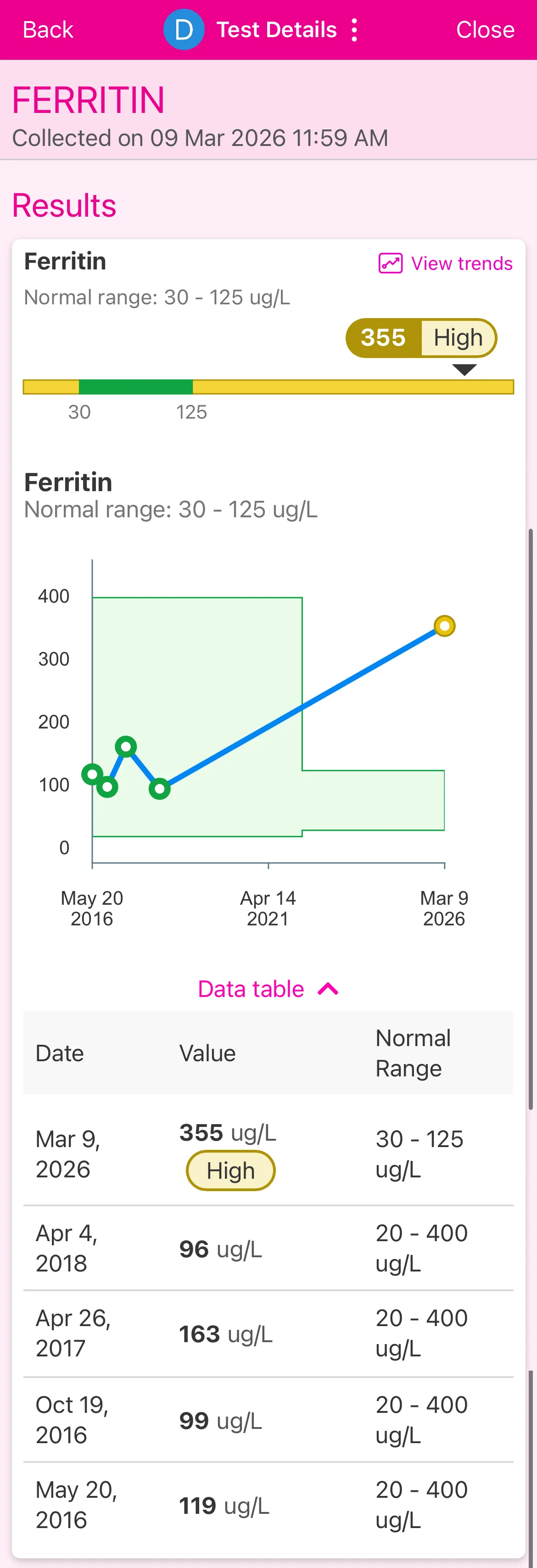
My ferritin is 355 ug/L, so I'm dealing with the reverse problem. Have you thought about eating more red meat? That's what did it for me.

MTSpace
Explorer
Right now my ferritin sits at 19. Joints ache, my legs feel restless, I can't handle as much work, climbing a flight of stairs that normally wouldn't wind me leaves me short of breath, I feel wired yet exhausted, and I wake up during the night instead of sleeping straight through. I carry hereditary hemachromotosas h63d homogyzous, and whenever my hematologist draws too much blood during phlebotomy and my ferritin drops below 40, all of these problems show up. TRT is something I recently began, and it has made things harder because my hematocrit climbs fast. I'm now drinking more water with electrolytes than I ever have. So far iron supplements haven't helped. Once I keep learning from this group, I'll try a different type of iron supplement. There's another hematologist appointment later this week.
FlowerFairy
Explorer
Pairing it with vitamin C, or a food rich in vitamin C, can boost how well iron and calcium are absorbed. Just make sure iron and calcium are kept at least 4 hours apart. For me, this makes a big difference!laansasa said:
Appreciate the details. Went ahead and bought polysaccharide iron—fingers crossed it goes in more easily than the heme iron I'm on now.FlowerFairy said:
cldfront said:
What number were you actually at? My PA is a total doofus running my medical care, and my ferritin came back at 12.1 last time (iron was 17.9). I sometimes think about what I could do if my body had the right amount of iron. My PA won't do anything except keep ordering tests, and everyone's just waiting on menopause to sort my shit out.dogmom said:
Every couple of years or so, I end up needing iron infusions. Back in January, my ferritin was significantly lower than that. I just went through a round of injections not long ago.
As for the OP, every day I use OTC supplements: 27mg of ferrous gluconate plus Thorne "Advanced Iron Complex" 36mg Ferrous Bisglycinate Chelate, and I also try to regularly eat high iron foods such as oysters/shellfish.
Try switching to polysaccharide iron. It gets taken up by the body more effectively, and if ferrous sulfate hasn't helped you at all, that means it isn't being absorbed. I spent years anemic while on FeSO4 too. According to my hematologist, taking it was basically the same as swallowing gravel.
FlowerFairy
Explorer
Seasoning matters more than merely greasing the surface—YouTube has plenty of solid tutorials on how to season cast iron. I'm based in Houston, where the humidity is relentless; my pediatrician used to joke that locals have gills instead of lungs. A Russian physician once told me 80-100% humidity can't happen unless it's raining. After a lifetime here, I politely disagree. I was raised cooking with cast iron skillets, griddles, and Dutch ovens. Rust has only appeared when I relocated and left them boxed up for an extended period. These pans belonged to my grandmother, so I'm somewhat tied to them.desinr-gal said:
I gave every option a shot. Coating the thing fully in oil before each use was genuinely annoying, and it ended up getting oil on the shelf and elsewhere. In Hawaii, the air's moisture and salt content makes it especially harsh.jason370 said:
To stop rust, just put a thin layer of oil on the cast iron pan. If you place it in the oven with that oil on it, the oil will set and form a shield — you’ll need to repeat this every so often.desinr-gal said:
Being mostly vegan means low iron stores come up for me again and again.
Throughout the day I work in foods that carry iron, and the first one is my coffee. Into a frothed latte go unsweetened cocoa powder and blackstrap molasses, since both deliver a lot of iron. Cinnamon and nutmeg go in as well, which bring the sugar down and make it taste better.
That accounts for 20% daily value.
After that comes a smoothie: protein powder, additional cocoa and molasses, plus creatine, collagen, amino acids and similar items, along with Kale and 1 cup of blueberries for vit C, which doubles how much of the iron the body can use. Whenever you eat or drink iron foods, pair them with citrus.
A cast iron pan helps a great deal, though in hawaii it is a hassle because it rusts so fast.
An iron fish is another option: place it in a pot of water so iron leaches into the water, add a squeeze of lemon once more, then pour it into your water bottle.
Lentils bring both iron and protein, so working them into meals is useful too, particularly when they are cooked alongside spinach and lemon.
Since I began these habits, my iron has stayed normal for years.
