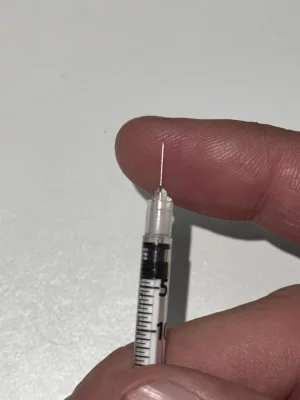
Dead space in syringes is throwing off my dosing

Herkimer P Shagnasty said:

bbbilly said:

I'd considered this before but assumed it wouldn't matter much (the puck), since it dissolves like a powder with lots of empty space. Hearing others mention it contributes .1ml to the total volume explains a lot about why my current batch (3, t30s into a new sterile vial) seems a bit weak.

Without realizing, I added an extra .3-4ml and messed up the math.
Assuming your calculations and premises hold up, you'd actually be receiving 91% of the intended dose. This gets worse when you use small water volumes and combine several vials into a cartridge or another container.

To reduce the problem, you could increase the water, for instance 2ml for each vial. That would bring you above 95% of the dose.

Alternatively, simply tweak the dose...
so yeah, the only sterile vials I've got are 5ml, and I mix to 4ml total. now that this is on my radar, I can dial in doses much better for my wife, my sister, and myself. all 3 of us had been saying this batch seemed a bit weak. turns out we were getting close to 10% less than what we believed we were injecting, and that was actually perceptible—not huge, but each of us felt like bumping up 1 or 2 units was necessary (at the time I calculated 0.227mg/unit)

this is exactly why I keep lurking here.. otherwise I'd have chalked it up to the batch being slightly underfilled, added a couple units, and moved on without a second thought. personally, this thread has been super helpful.

lessthanhalf said:

I'm not convinced the math checks out. When you add 0.1ml into 3ml of bac water, that's a 1/30 ratio (3.33%), or 1/31, but either way it's close. That means the largest possible error for any given dose is 3.3%. In practice, that's well inside the normal range of error you get from eyeballing doses in a small insulin syringe, and once you factor in tiny air bubbles and similar issues, doses are probably off by even more than that on a regular basis (my guess would be around +/- 0.1ml per dose, or 0.05ml if you're really careful). So my take is that this doesn't actually matter, because it falls within the measurement error you're already dealing with, and there's no method that would make it any more exact. That said, I am somewhat surprised that your dosing was consistent enough for you to pick up on this at all, and a 3% swing in dose is irrelevant, too minor to detect or have any real-world impact.
I put 3 vials together into 1, with 4ml of water total. some rough guesses in my math gave me a gap of 0.021mg/unit (I'm dosing 3 people at 3 different levels, so I always figure out the mg/unit to keep things simple for myself)

Herkimer P Shagnasty said:

woundcarping said:

Herkimer P Shagnasty said:

bbbilly said:

I'd considered this before but assumed it wouldn't matter much (the puck), since it dissolves like a powder with lots of empty space. Hearing others mention it contributes .1ml to the total volume explains a lot about why my current batch (3, t30s into a new sterile vial) seems a bit weak.

Without realizing, I added an extra .3-4ml and messed up the math.
Alternatively, filtering is an option. That method consistently appears to consume a few units.
Getting rid of the leftover reconstituted volume doesn't alter the concentration at all.
That's correct. It's unexpected that bbbilly picks up on it. A few percent either way doesn't concern me. Still, everyone's different
my sister and I are both extremely sensitive to meds. thanks to 2.5mg tirz, I've dropped around 90lbs. she began at 0.75mg, worked her way to 2.5mg, and is already down roughly 30lbs over the past 3 months.

my wife, though, has only lost about 8lbs on 3mg every 3 days lol
 
lessthanhalf said:

I'm not convinced the math checks out. When you add 0.1ml into 3ml of bac water, that's a 1/30 ratio (3.33%), or 1/31, but either way it's close. That means the largest possible error for any given dose is 3.3%. In practice, that's well inside the normal range of error you get from eyeballing doses in a small insulin syringe, and once you factor in tiny air bubbles and similar issues, doses are probably off by even more than that on a regular basis (my guess would be around +/- 0.1ml per dose, or 0.05ml if you're really careful). So my take is that this doesn't actually matter, because it falls within the measurement error you're already dealing with, and there's no method that would make it any more exact. That said, I am somewhat surprised that your dosing was consistent enough for you to pick up on this at all, and a 3% swing in dose is irrelevant, too minor to detect or have any real-world impact.

Suppose he combines 3 vials — the discrepancy would land somewhere around .3-.4ml against a solution total nobody knows, though if we plug in your 3ml figure that works out to roughly a ~9% error. (While I was drafting this he posted 4ml, which still comes out near ~9%.)

Take my own case: 140mg brought up to a 3.5ml total volume = 40mg/ml. What I actually saw was a .2ml shift, and leaving that uncorrected would have made the total 3.7ml, or 37.8mg/ml — about a ~5.4% error.

Claiming the usual dosing error sits at .1ml, or .05ml at the very best, is ridiculous — particularly from you. On my everyday .3ml syringe, that figure is a full 1/3 of the barrel. Did a meaningful zero maybe get dropped? Even plus or minus .01ml remains a sizable error when a .3ml syringe has hashmarks marking .005ml. I realize I likely know more about metrology than most, but anyone should be able to nudge the plunger to within a hashmark or two. With water based solutions, the bubbles tend to be about the size of a hashmark, it appears (and they don't consume much of the cross-section).


1786937382530-webp.36060
 

Attachments

  • b2b608fc4769c9712b3f92b2e53209b42a00a08df39c839f99c8e0caff97f7f0.webp
    b2b608fc4769c9712b3f92b2e53209b42a00a08df39c839f99c8e0caff97f7f0.webp
    31.8 KB · Views: 4
Alright, I've read everyone's take on this...and if the argument is that the powder contributes to the volume of the mixed peptide, then why does the exact same thing happen with every vial I go through...as I mentioned earlier, I could accept it during use of a multi dose vial, since drawing many doses from 1 vial might introduce some inaccuracy. But this occurs even with vials that only give 2 or 3 doses. The final 1 always comes out larger. The syringes I use for reconstituting are proper ones, and I don't believe they're inaccurate...and no, I don't filter.
 
ultima thule said:

Alright, I've read everyone's take on this...and if the argument is that the powder contributes to the volume of the mixed peptide, then why does the exact same thing happen with every vial I go through...as I mentioned earlier, I could accept it during use of a multi dose vial, since drawing many doses from 1 vial might introduce some inaccuracy. But this occurs even with vials that only give 2 or 3 doses. The final 1 always comes out larger. The syringes I use for reconstituting are proper ones, and I don't believe they're inaccurate...and no, I don't filter.
Have you verified how much your reconstitution syringes really hold? The graduation markings could be printed with a consistent inaccuracy. Based on the specific model and how well it is made, the maker might allow a 10% tolerance. Precision measurement is not what these syringes are designed for.
 
ShimrodsPhial said:

ultima thule said:

Alright, I've read everyone's take on this...and if the argument is that the powder contributes to the volume of the mixed peptide, then why does the exact same thing happen with every vial I go through...as I mentioned earlier, I could accept it during use of a multi dose vial, since drawing many doses from 1 vial might introduce some inaccuracy. But this occurs even with vials that only give 2 or 3 doses. The final 1 always comes out larger. The syringes I use for reconstituting are proper ones, and I don't believe they're inaccurate...and no, I don't filter.
Have you verified how much your reconstitution syringes really hold? The graduation markings could be printed with a consistent inaccuracy. Based on the specific model and how well it is made, the maker might allow a 10% tolerance. Precision measurement is not what these syringes are designed for.
I hadn't done that, though I'm thinking I will now. As @Herkimer P Shagnasty mentioned in his post, I'll grab an empty vial and test it that way. That said, these syringes came from a medical store rather than Amazon, so I assumed they'd be accurate. Perhaps my confidence in them is misplaced.
 
ultima thule said:

ShimrodsPhial said:

ultima thule said:

Alright, I've read everyone's take on this...and if the argument is that the powder contributes to the volume of the mixed peptide, then why does the exact same thing happen with every vial I go through...as I mentioned earlier, I could accept it during use of a multi dose vial, since drawing many doses from 1 vial might introduce some inaccuracy. But this occurs even with vials that only give 2 or 3 doses. The final 1 always comes out larger. The syringes I use for reconstituting are proper ones, and I don't believe they're inaccurate...and no, I don't filter.
Have you verified how much your reconstitution syringes really hold? The graduation markings could be printed with a consistent inaccuracy. Based on the specific model and how well it is made, the maker might allow a 10% tolerance. Precision measurement is not what these syringes are designed for.
I hadn't done that, though I'm thinking I will now. As @Herkimer P Shagnasty mentioned in his post, I'll grab an empty vial and test it that way. That said, these syringes came from a medical store rather than Amazon, so I assumed they'd be accurate. Perhaps my confidence in them is misplaced.
The issue isn't about trusting anyone — it comes down to what a given instrument was built to do.

When labs need precise readings of tiny amounts, they reach for calibrated pipettes. A syringe isn't a pipette. Its markings exist to capture big differences, not subtle ones.

In commercial settings, big batches get blended and then dispensed into vials. Extra volume is common, but concentration is what actually counts.


The reason these headaches land on us (and on you) is that our scale, our equipment, and our procedures all differ from the industrial ones.

Should those few missing milligrams genuinely cause you trouble, several sensible fixes have already come up — diluting further, or recalculating based on the true final concentration — but there's a ceiling here: a bit will always remain behind, either in the barrel or in the vial.

Still, I get why it grates. Same deal when I whip up chocolate mousse: there's always some clinging to the bottom of the bowl, and tossing that chocolate would be a crying shame.😋
 
Measuring involves several stacked 'errors,' in my view. First, there are assumptions about your fill, which come from different vial(s) rather than the one you're actually reconstituting. Then there's the syringe reading error, manufacturing system error in the syringe itself, and possible dead space variation across needle, syringe, and filter makers… it keeps going. Mitigation is really all you can do. I usually don't stress about it much and tweak the dose when I feel it's needed (Tirz); with peps that give no sides or feels, that's not as straightforward.
 
ShimrodsPhial said:

ultima thule said:

ShimrodsPhial said:

ultima thule said:

Alright, I've read everyone's take on this...and if the argument is that the powder contributes to the volume of the mixed peptide, then why does the exact same thing happen with every vial I go through...as I mentioned earlier, I could accept it during use of a multi dose vial, since drawing many doses from 1 vial might introduce some inaccuracy. But this occurs even with vials that only give 2 or 3 doses. The final 1 always comes out larger. The syringes I use for reconstituting are proper ones, and I don't believe they're inaccurate...and no, I don't filter.
Have you verified how much your reconstitution syringes really hold? The graduation markings could be printed with a consistent inaccuracy. Based on the specific model and how well it is made, the maker might allow a 10% tolerance. Precision measurement is not what these syringes are designed for.
I hadn't done that, though I'm thinking I will now. As @Herkimer P Shagnasty mentioned in his post, I'll grab an empty vial and test it that way. That said, these syringes came from a medical store rather than Amazon, so I assumed they'd be accurate. Perhaps my confidence in them is misplaced.
The issue isn't about trusting anyone — it comes down to what a given instrument was built to do.

When labs need precise readings of tiny amounts, they reach for calibrated pipettes. A syringe isn't a pipette. Its markings exist to capture big differences, not subtle ones.

In commercial settings, big batches get blended and then dispensed into vials. Extra volume is common, but concentration is what actually counts.


The reason these headaches land on us (and on you) is that our scale, our equipment, and our procedures all differ from the industrial ones.

Should those few missing milligrams genuinely cause you trouble, several sensible fixes have already come up — diluting further, or recalculating based on the true final concentration — but there's a ceiling here: a bit will always remain behind, either in the barrel or in the vial.

Still, I get why it grates. Same deal when I whip up chocolate mousse: there's always some clinging to the bottom of the bowl, and tossing that chocolate would be a crying shame.😋
Normally I wouldn't kick up a fuss, but my usual approach is to mix 10mg of the compound into 1ml of bac water whenever that's doable and convenient. That means 10 units translates to a 1mg shift per dose, which is a pretty significant gap....regardless, I'm going to check what my syringe actually holds and figure out what's going on here...
 
ultima thule said:

Alright, I've read everyone's take on this...and if the argument is that the powder contributes to the volume of the mixed peptide, then why does the exact same thing happen with every vial I go through...as I mentioned earlier, I could accept it during use of a multi dose vial, since drawing many doses from 1 vial might introduce some inaccuracy. But this occurs even with vials that only give 2 or 3 doses. The final 1 always comes out larger. The syringes I use for reconstituting are proper ones, and I don't believe they're inaccurate...and no, I don't filter.

I realize English may not be your native tongue.

Vials meant for 2-3 doses still count as “multi dose vials.”

Whether a vial is “multi dose” or single dose has zero bearing on any part of this discussion.

The puck itself takes up space, and the vast majority of that space is not the active compound.

“The last one is always bigger” — no. Your dose is simply a set volume at a set concentration. You pulling out every last bit of volume is something you are doing, not something the dose is doing. If that reassures you, draw roughly an extra .15ml on your first dose and your final one will suddenly “come out right.”

There is nothing mythical or advanced-physics about this… when you add 3ml to a puck whose reconstituted volume is .15ml, the reconstituted volume you end up with will always exceed 3ml.
 
woundcarping said:


If he's putting 3 vials together, the error would be .3-.4ml in an unknown total amount of solution, but using your 3ml, that would be a ~9% error. (Since I started writing he's posted it's 4ml, still around a ~9% error).

In my example I reconstituted 140mg with 3.5ml of total volume= 40mg/ml. The observed volume change was .2ml, which uncorrected would have put the total volume at 3.7ml or 37.8mg/ml, a ~5.4% error.

The assertion that typical dosing error is .1ml and at best .05ml is absurd, especially coming from you. That's 1/3 the total volume of my typical .3ml syringe. Perhaps you left out a significant zero? Plus or minus .01ml is still a large error with a .3ml syringe hashmarks denoting .005ml. I get that I'm probably more knowledgable about metrology than average, but surely the average person can move the plunger to within a width or two of the hashmark. The bubbles on water based solutions are typically similar in size to a hashmark, it seems (and don't take up a significant portion of the cross-section).

View attachment 36060

Click to expand...
Yeah, my math and reading skills were awful — I didn't catch how the vials had been reconstituted, and my amounts ended up off by a factor of 10. For proper dose accuracy, you'd want +/- 0.01ml to 0.005ml per dose, which just goes to show how simple it is to be off by a factor of 10 when dosing.
 
woundcarping said:

The lyophilized puck itself takes up space—usually somewhere between .1 and .2ml. That lines up precisely with the extra "10 units" you're seeing.

If precision matters to you, then you compensate by changing how much bac water you add, factoring in that puck volume. That way, both your final volume and your concentration come out correct.
Huh, that explains it.

This exact thing happened to me when my last deployment wrapped up. Filters, cartridges, pen needles — all gone. I was left with just a handful of diabetic syringes and one vial of Tirz. So I mixed TR60 using 1.6ml and administered 40 unit doses to get 15mg/6D.

Then came the 4th and final dose: 55 units! I said screw it and injected it anyway. Still, I couldn't figure out why.

Thanks for the probable explanation.

My tinnitus and dysesthesia hit me like a truck the following day, though!
 
Mine went the other way. The first Reta vial I used, which a friend had mixed up for me, appeared to be short by 5 units. I was sure I measured right on each draw, yet I ended up doubting myself. Then a motsc vial I mixed on my own did the same thing — 5 units gone. I have no idea what mistake I made.
 
woundcarping said:

The lyophilized puck itself takes up space—usually somewhere between .1 and .2ml. That lines up precisely with the extra "10 units" you're seeing.

If precision matters to you, then you compensate by changing how much bac water you add, factoring in that puck volume. That way, both your final volume and your concentration come out correct.
Hmm, that makes sense and accounts for why there's extra left at the finish.

restingbeachface said:

Mine went the other way. The first Reta vial I used, which a friend had mixed up for me, appeared to be short by 5 units. I was sure I measured right on each draw, yet I ended up doubting myself. Then a motsc vial I mixed on my own did the same thing — 5 units gone. I have no idea what mistake I made.
Do your reconstitution syringes and injection syringes, or your pen, measure accurately?
 
BNLFL said:

woundcarping said:

The lyophilized puck itself takes up space—usually somewhere between .1 and .2ml. That lines up precisely with the extra "10 units" you're seeing.

If precision matters to you, then you compensate by changing how much bac water you add, factoring in that puck volume. That way, both your final volume and your concentration come out correct.
Hmm, that makes sense and accounts for why there's extra left at the finish.

restingbeachface said:

Mine went the other way. The first Reta vial I used, which a friend had mixed up for me, appeared to be short by 5 units. I was sure I measured right on each draw, yet I ended up doubting myself. Then a motsc vial I mixed on my own did the same thing — 5 units gone. I have no idea what mistake I made.
Do your reconstitution syringes and injection syringes, or your pen, measure accurately?
For 10 mg, I drew with 2 syringes of .5 cc. Easy touch.
 
restingbeachface said:

BNLFL said:

woundcarping said:

The lyophilized puck itself takes up space—usually somewhere between .1 and .2ml. That lines up precisely with the extra "10 units" you're seeing.

If precision matters to you, then you compensate by changing how much bac water you add, factoring in that puck volume. That way, both your final volume and your concentration come out correct.
Hmm, that makes sense and accounts for why there's extra left at the finish.

restingbeachface said:

Mine went the other way. The first Reta vial I used, which a friend had mixed up for me, appeared to be short by 5 units. I was sure I measured right on each draw, yet I ended up doubting myself. Then a motsc vial I mixed on my own did the same thing — 5 units gone. I have no idea what mistake I made.
Do your reconstitution syringes and injection syringes, or your pen, measure accurately?
For 10 mg, I drew with 2 syringes of .5 cc. Easy touch.
Are you talking about Easy Touch in .5ml and 1ml? And what do you use for reconstitution—do you filter?
 
BNLFL said:

restingbeachface said:

BNLFL said:

woundcarping said:

The lyophilized puck itself takes up space—usually somewhere between .1 and .2ml. That lines up precisely with the extra "10 units" you're seeing.

If precision matters to you, then you compensate by changing how much bac water you add, factoring in that puck volume. That way, both your final volume and your concentration come out correct.
Hmm, that makes sense and accounts for why there's extra left at the finish.

restingbeachface said:

Mine went the other way. The first Reta vial I used, which a friend had mixed up for me, appeared to be short by 5 units. I was sure I measured right on each draw, yet I ended up doubting myself. Then a motsc vial I mixed on my own did the same thing — 5 units gone. I have no idea what mistake I made.
Do your reconstitution syringes and injection syringes, or your pen, measure accurately?
For 10 mg, I drew with 2 syringes of .5 cc. Easy touch.
Are you talking about Easy Touch in .5ml and 1ml? And what do you use for reconstitution—do you filter?
Yes, the units can be used interchangeably, but you're right — both the .5 ml and 1 ml are Easy Touch. I had that wrong. For reconstitution I used a 1 ml syringe, and for pinning I used a .5 ml one.
 
BNLFL said:

restingbeachface said:

BNLFL said:

woundcarping said:

The lyophilized puck itself takes up space—usually somewhere between .1 and .2ml. That lines up precisely with the extra "10 units" you're seeing.

If precision matters to you, then you compensate by changing how much bac water you add, factoring in that puck volume. That way, both your final volume and your concentration come out correct.
Hmm, that makes sense and accounts for why there's extra left at the finish.

restingbeachface said:

Mine went the other way. The first Reta vial I used, which a friend had mixed up for me, appeared to be short by 5 units. I was sure I measured right on each draw, yet I ended up doubting myself. Then a motsc vial I mixed on my own did the same thing — 5 units gone. I have no idea what mistake I made.
Do your reconstitution syringes and injection syringes, or your pen, measure accurately?
For 10 mg, I drew with 2 syringes of .5 cc. Easy touch.
Are you talking about Easy Touch in .5ml and 1ml? And what do you use for reconstitution—do you filter?
Oh, and there's no filtering either.
 
I ran a test. I took a bunk vial of Kpv10 to verify it. I added 1ml of water into the sealed vial containing a puck and let it dissolve. Then I took an insulin 1ml syringe and pulled the solution back out. It came to more than 1ml, roughly 10unit/.1ml. After that I put only water into the same vial, using the same syringe, and again 1ml. The outcome was identical. So: my reconstitution syringes aren't accurate, and in the end the puck contributes nothing to the volume of the reconstituted peptide.
 
ultima thule said:

I ran a test. I took a bunk vial of Kpv10 to verify it. I added 1ml of water into the sealed vial containing a puck and let it dissolve. Then I took an insulin 1ml syringe and pulled the solution back out. It came to more than 1ml, roughly 10unit/.1ml. After that I put only water into the same vial, using the same syringe, and again 1ml. The outcome was identical. So: my reconstitution syringes aren't accurate, and in the end the puck contributes nothing to the volume of the reconstituted peptide.

So you acknowledge that your gear lacks precision, and from that admission you jump to a conclusion that contradicts fairly basic physics.

Great job.
 
Back
Top